I love Spain. Not only that, traveling there is easier because I can at least imperfectly speak the language, having spent a semester in college in Bogotá way back in 1977. Much of Spain gets too hot for pleasant cycling in the summer so my friend Lyman and I hoped our mid-May departure would give us decent weather. We got lucky on that, with daily lows in the forties and highs in the sixties. The week after our trip ended, temperatures in Spain skyrocketed.
I really don’t like flying but there is no other way to Europe. I try to get air travel over with quickly and I had a bunch of miles on American Airlines. A nonstop from Charlotte NC airport to Madrid leaves every day at 3:30 PM. Rather than flying from the much closer Raleigh/Durham airport and having to change planes, I booked an Amtrak to downtown Charlotte, and Tootie would drive me to the Durham station. I loaded in our Ford Escape Hybrid the curved green suitcase that contained my folding Bike Friday and a blue canvas bag packed with my other stuff. Not shown: my ukulele in a soft canvas case.
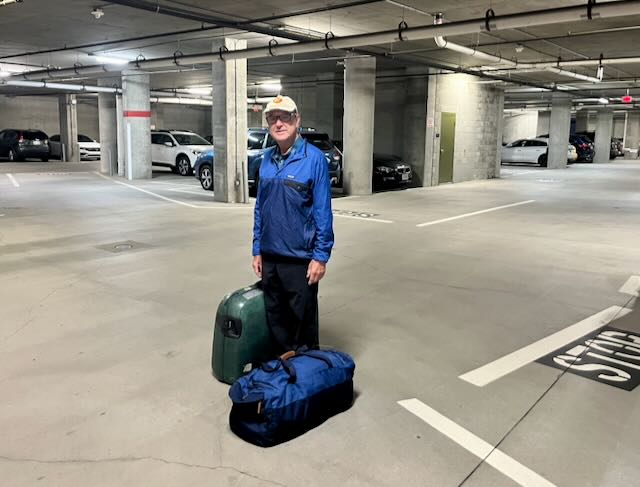
Half an hour later at 7:05 AM I boarded the Charlotte-bound Amtrak at the Durham NC platform.
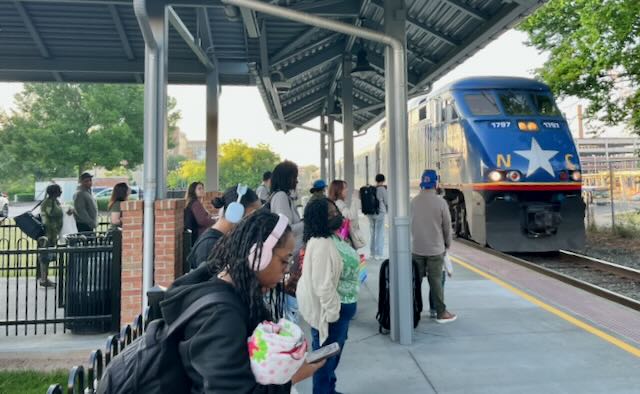
With financial support from the state government Amtrak now has five trains a day running Raleigh to Durham to Greensboro to Charlotte. My ride from Durham was two and a half hours. Of course I had to take an Uber from the Charlotte station out to its airport.
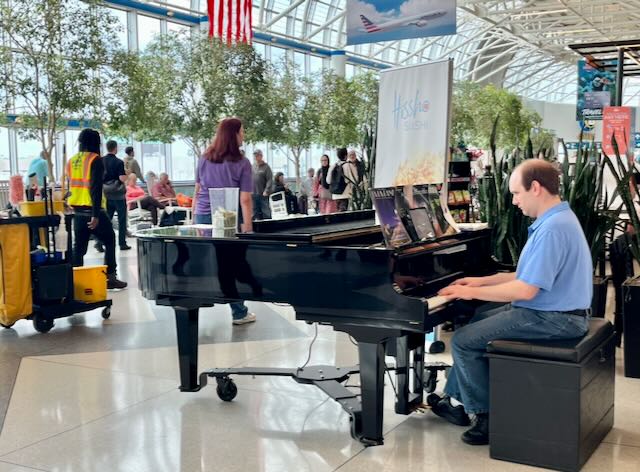
At the airport I still had a few hours to kill. Those of us in the Raleigh/Durham area like to make fun of Charlotte for being a stodgy banker’s town but CLT airport has its charms. For as long as I can remember the area between concourses B and C has had wooden rocking chairs and a Yahama grand piano. A likely amateur played both 1970’s hits and Mozart; no singing, just the un-amplified voice of an acoustic piano. I sat at the nearby bar of a restaurant called Hissho Sushi enjoying lunch; a Hawaiian style poke bowl.
The flight took about eight hours, landing at five something in the morning Madrid time. I still had to hang around the Madrid airport for nearly four hours so I could meet Lyman who was flying in from Austin TX.
In the past ten or fifteen years Lyman and I have done a bunch of bike trips together. We are getting on in years. I am nearly seventy-one and he is seventy-four. When Lyman first visited Spain on a Eurailpass in 1974 it was essentially a third-world country with a Fascist government. Two years later in 1976 I bicycled across Spain with my friend Vince. Franco had just died but Spain was only beginning to change. Since then Spain has modernized in leaps and bounds.
I had chosen the medieval city of Segovia as the point to start bike riding. From central Madrid to Segovia by car would be a twisting hour and a half drive. Modern Spain has another way; high-speed rail does those fifty miles from central Madrid’s Chamartin station to an outlying Segovia station in TWENTY-SIX MINUTES, much of it in tunnels through the mountains.
Lyman and I went by subway from the airport to Chamartín station, where we took our Bike Fridays out of the hard suitcases. We sent the empty suitcases by Uber to a nearby hotel we had reserved for the final night. High speed rail here does not permit regular bicycles. We had to put the folded bicycles in our canvas bags then uncomfortably lug these folded bikes down a lengthy station platform.
On arrival at the Segovia station we assembled our Bike Fridays, strapped on all our luggage, and cycled through misty semi-rain the couple of miles into town. Biking felt like freedom!
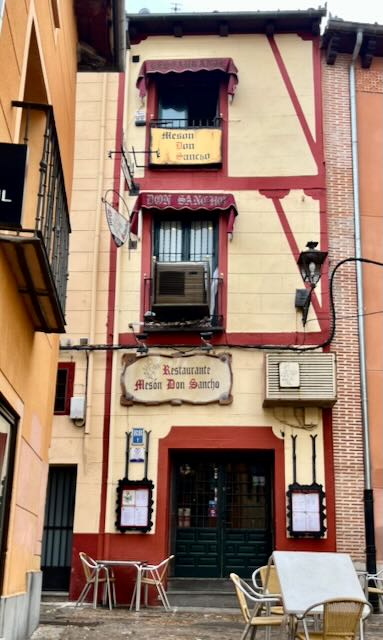
Jet-lag be damned, it was lunchtime. In the city center we discovered Mesón Don Sancho on a narrow back street. The ground floor bar of a narrow house led to a second floor dining room.
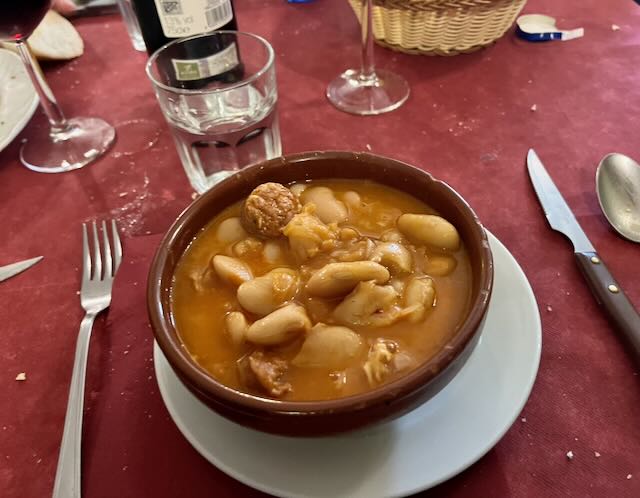
My first course was a soup of huge local lima-type beans called judión.
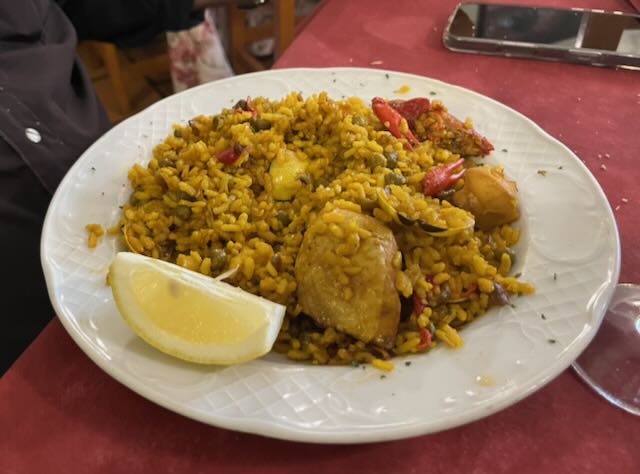
Lyman’s first course was paella.
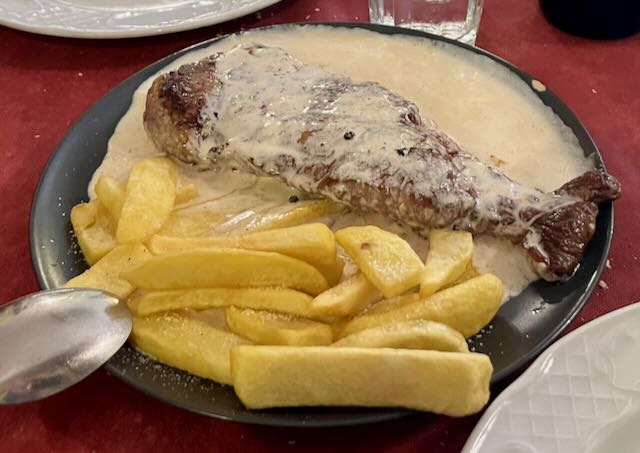
We split a steak with cream sauce.
There was flan for dessert.
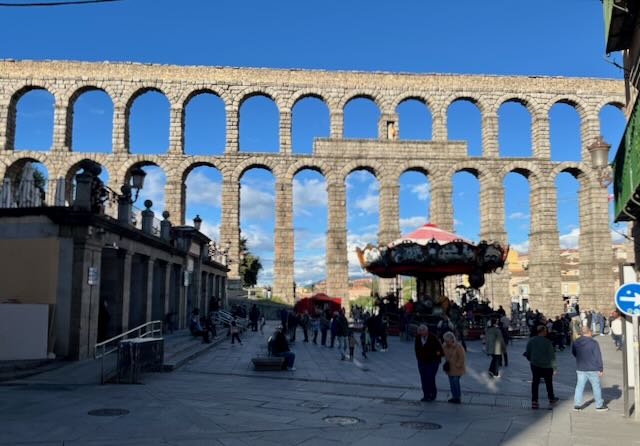
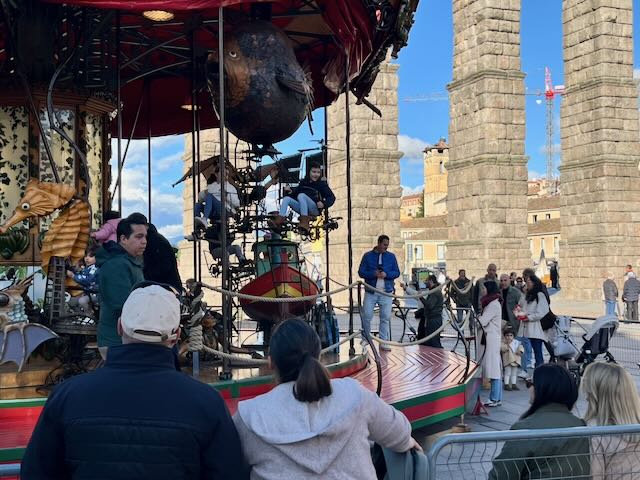
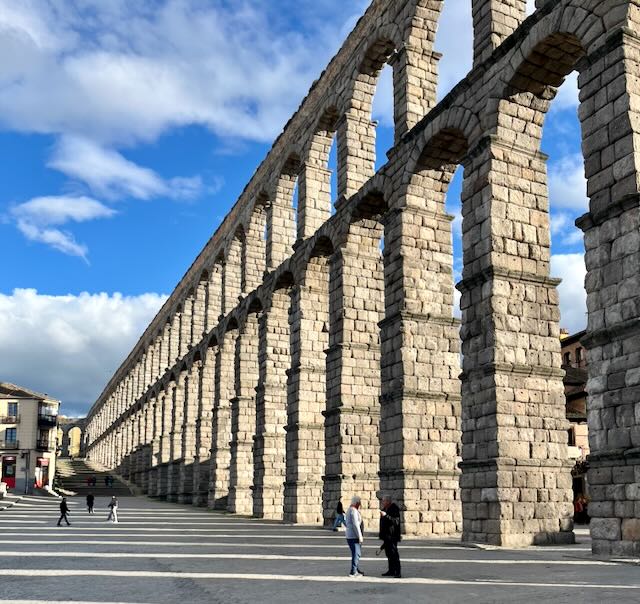
As a retired architect who specialized in historic preservation, Lyman really likes looking at old bridges. Segovia’s Roman aqueduct fits into that same category. It is about two thousand years old and threads right through the center of town. It carried municipal water supplies until 1974. A modern children’s carousel in Steampunk style adds to the vibe
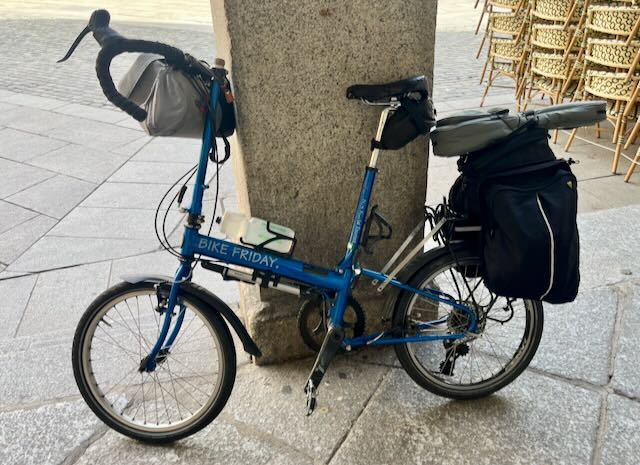
The next morning outside our hotel in central Segovia I loaded my bags and the ukulele on the bicycle.
Segovia is a major draw. We saw parking lots filled with huge buses presumably for day trippers from Madrid. Escorted tour groups were ubiquitous in the streets. Of course not all tourists are American, but after leaving Segovia we saw almost no tourists and absolutely no other Americans for the next six days.
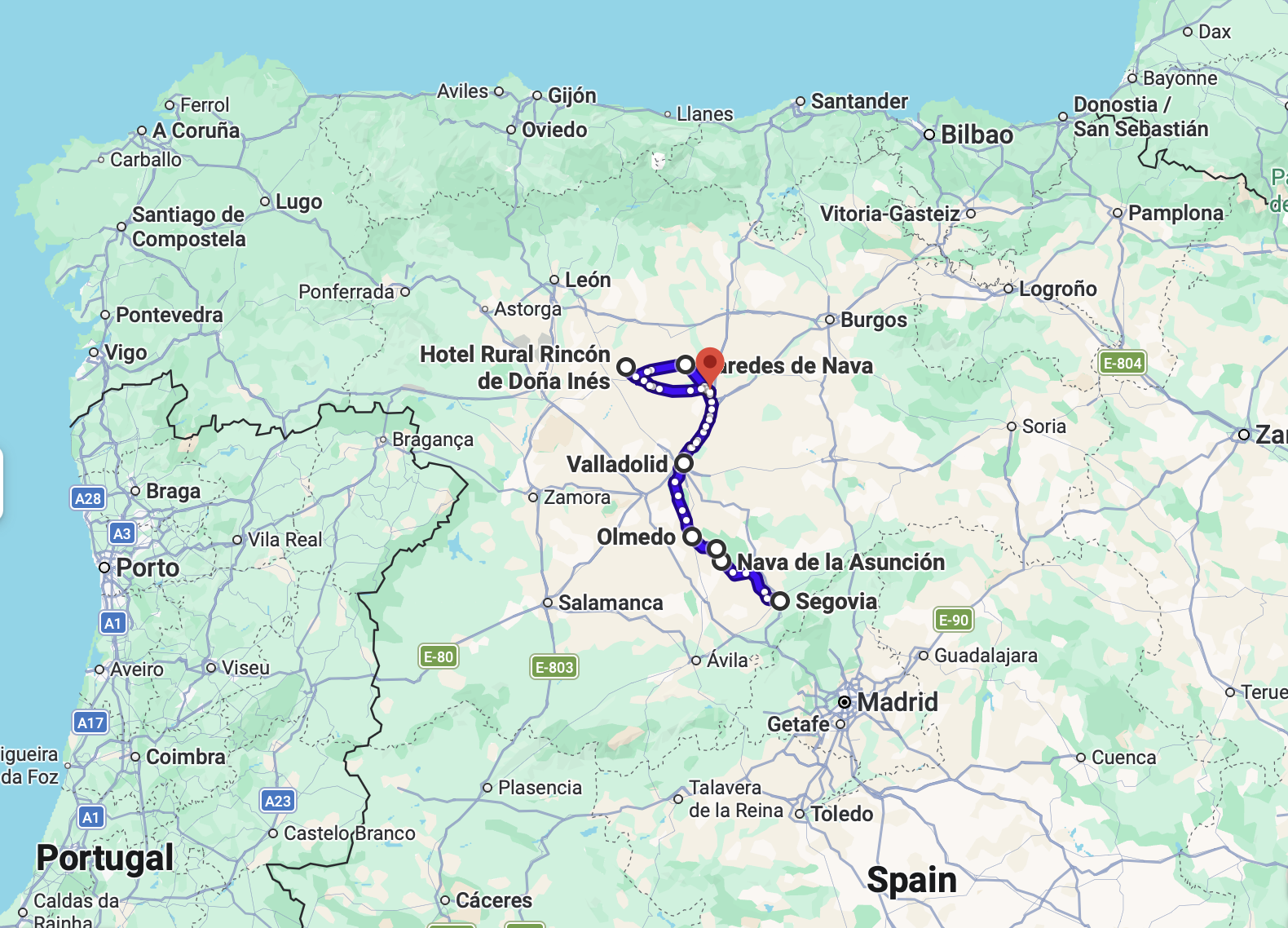
I had an open agenda as to where two seventy-something guys could spend a week cycling in Spain. I thought: downhill is better than uphill, flat is better than hilly, and very small towns are better than even mid-sized cities. I plotted a route going northwest towards the city of León. Here is the route we ultimately cycled the next seven days.
Cycling within Segovia, population 50,000, felt like biking around a city bigger than it is; it seemed an enormous hilly car-filled metropolis. Every street was one-way in the wrong direction as we had trouble finding a specific rail-trail bike path that started on the southwest outskirts of town. We exhausted ourselves with nearly two hours cycling up and down steep hills in heavy traffic. We finally did locate the “Via Verde del Eresma.”
Once on the trail, cycling was delightful. The trail extends for about forty miles into a more rural area and away from heavy car traffic. The former rail line included the occasional tunnel.
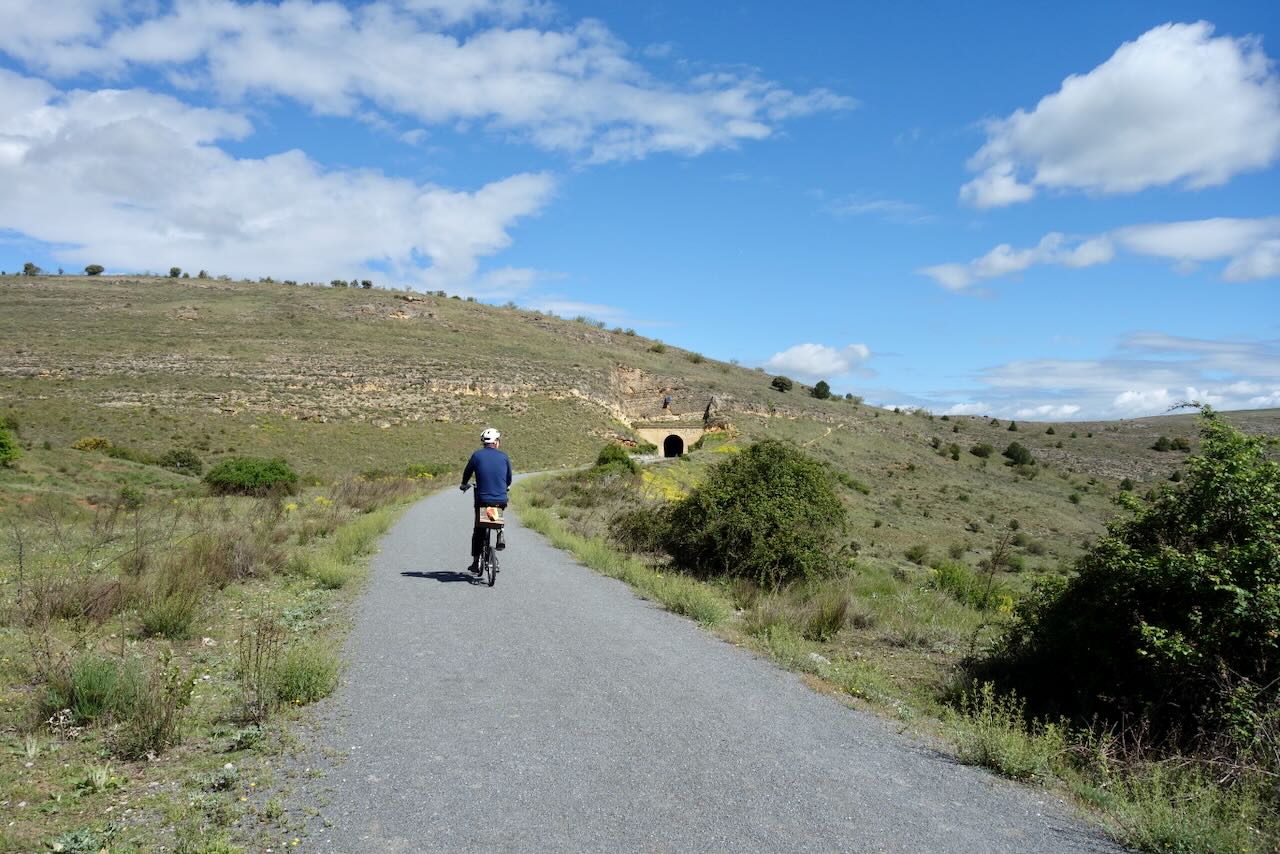
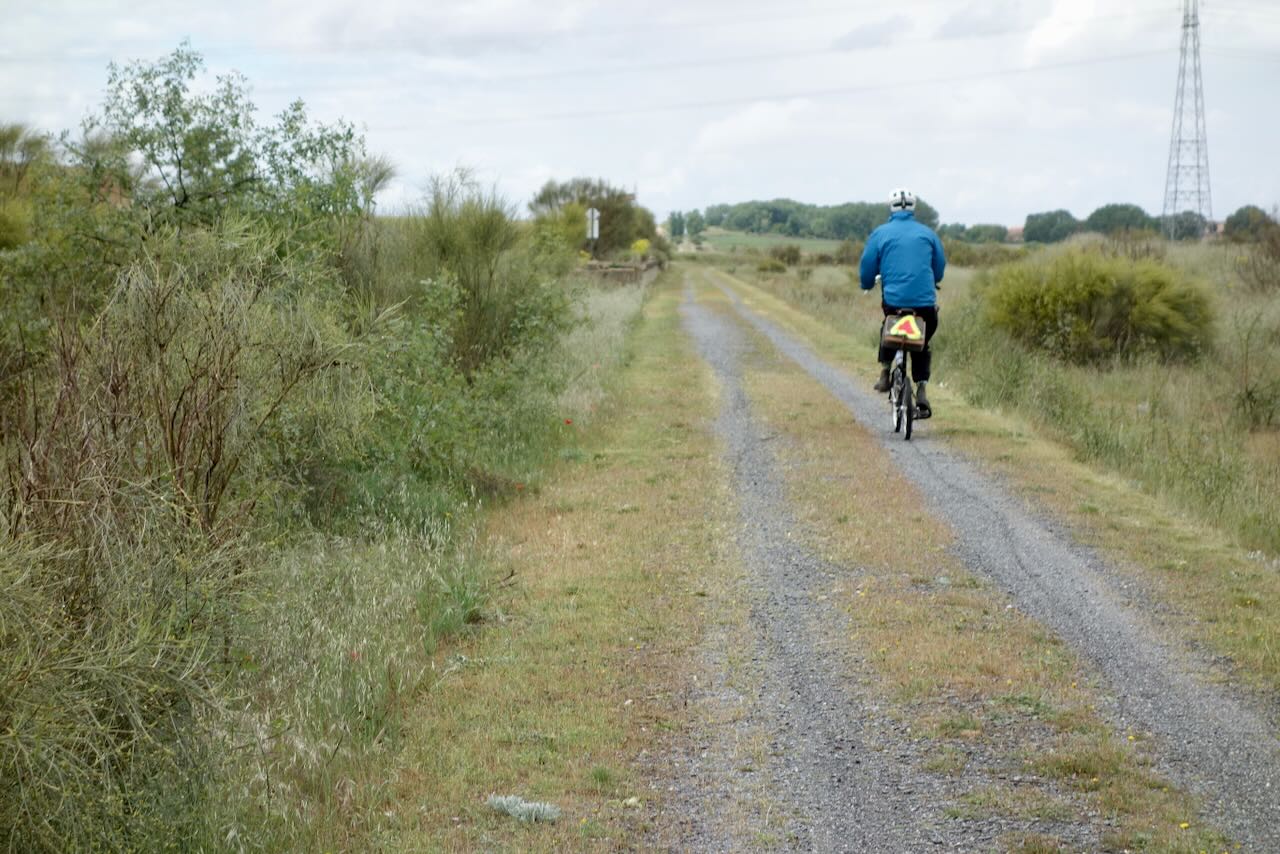
Further on, the surface of the trail deteriorated.
It was so great to be out here that I could not help myself and had to stop and play a song!
We had not had any lunch and it looked like rain. Sometime mid-afternoon we ducked into a bar called Punto de Ecuentro in the town of Nava de la Asunción, population 2,600. Men were hanging around.
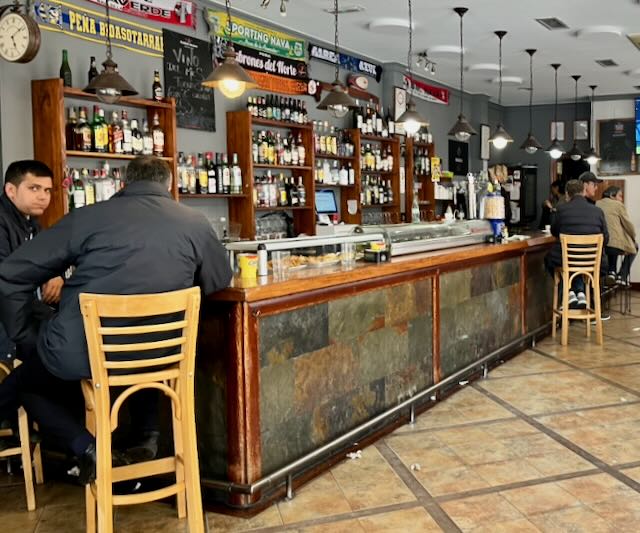
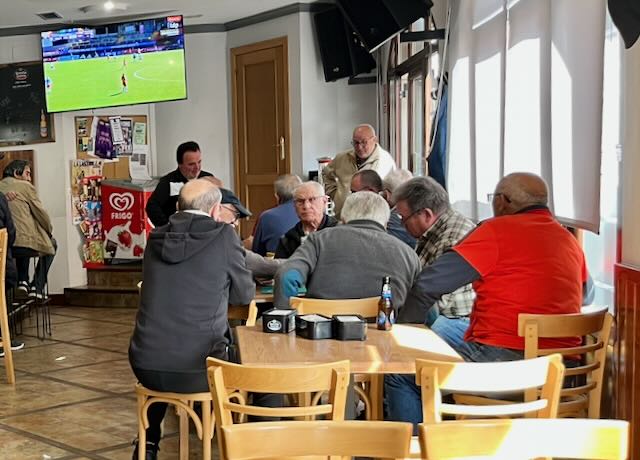
With supreme luck, we looked out of the bar windows to see the light drizzle through which we had been cycling change into a torrential downpour. I rushed out to move the bicycles under the awning but otherwise we were dry and cozy.
Spanish friends had given me coaching about bar lingo. I already knew that a small glass of draft beer is a “caña” but I did not know that a larger glass of beer, about the size of a normal beer in America, is “dos cañas”, a “doble.”
We ordered dobles. The bar was lined with tapas. I ordered a few mussels and asked about those other things. She called them “orejas” which is “ear.”
Pig’s ears! Lyman was grossed out but to me it was like eating bacon. What’s not to like? Bread was included.
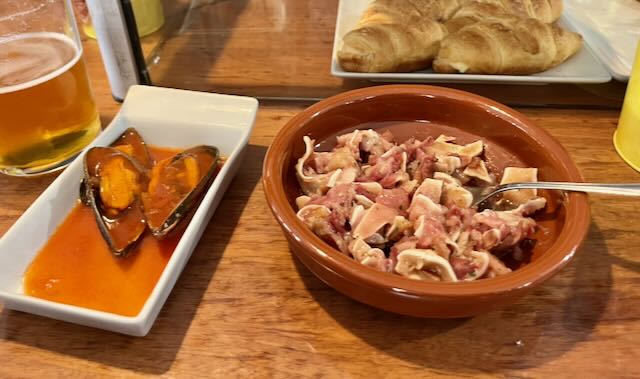
This was to serve as our late lunch. Eventually the rain had stopped and we had to move on. Only five or ten miles down the road was the similar sized town of Coca, population 1,800. There were no hotels but we did locate an Airbnb of an entire two bedroom house. We could walk to the town center.
Of the five restaurants in town, three were closed because it was a Monday. The other two showed staying open until 11:00 PM but at 8:55 PM both had apparently just closed. A guy outside one said no customers had showed, so why stay open? We walked away, dejectedly. Luckily, our Airbnb host had left us a bottle of wine plus a lame “breakfast” of pre-packaged melba toast. Our dinner that night ended up being toast, butter, olive oil, and jam washed down with the local white.
It rained the next morning so we got a late start. Since we had had essentially no dinner the night before, around noon we went BACK to that restaurant called Enxebre for an early lunch (late breakfast?) The restaurant had just a few customers.
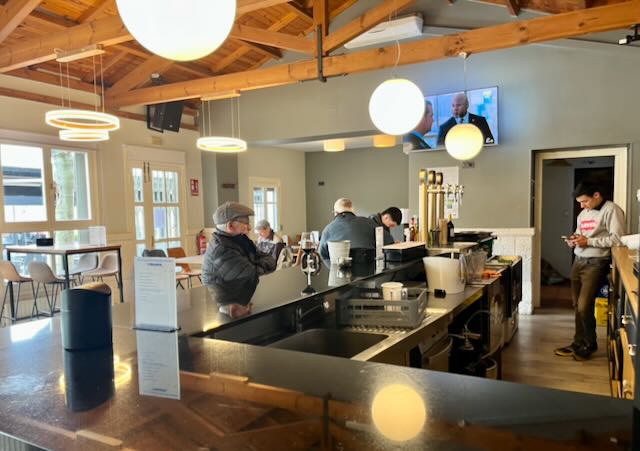
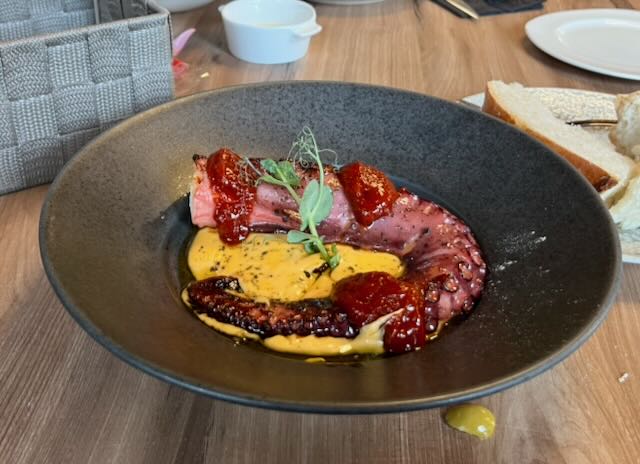
For a small town, Enxebre has aspirations of fancy cooking. I ordered octopus leg; it came with a colorful sauce.
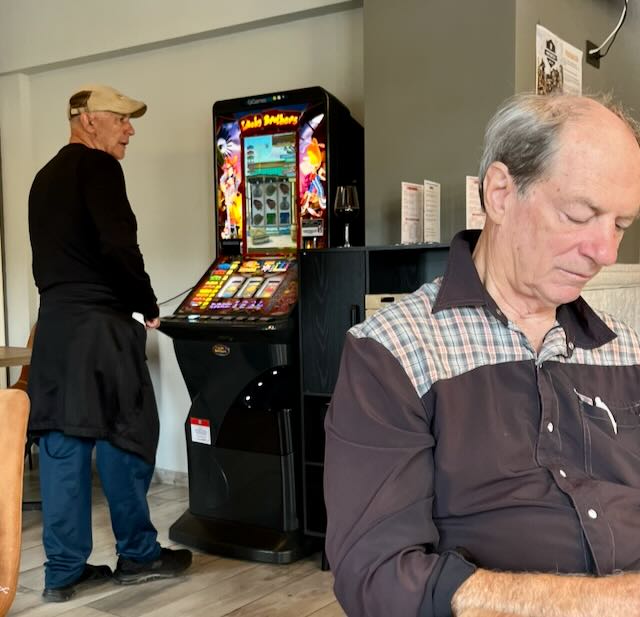
Outside a large group of police types were using the restaurant terrace for some kind of meeting; I found that mildly creepy. Behind Lyman, one old guy was playing a video gambling machine.
At nearly one in the afternoon we got our stuff together and cycled out of town. Once again, at least for a short while, we could use the Via Verde bike path, a former rail line.
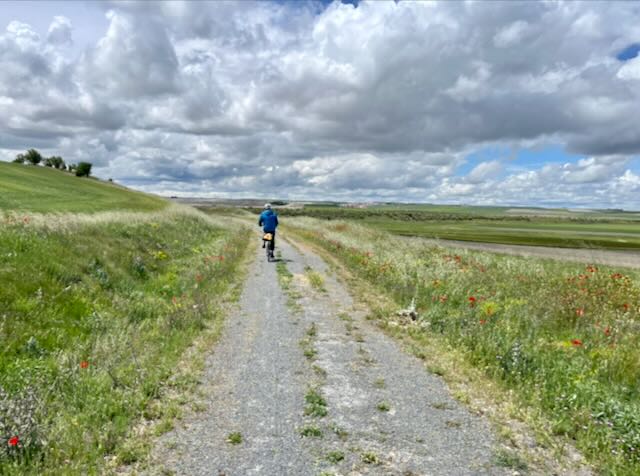
Nevertheless, we had issues. The scenery was lovely but the “trail” surface deteriorated.
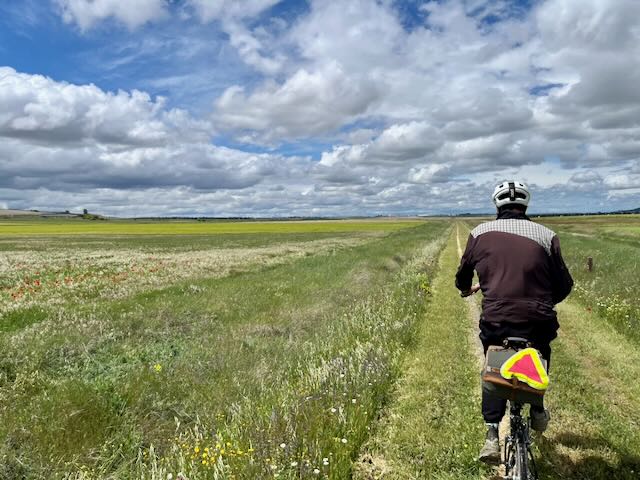
I had to stop and fix a flat tire. It started raining intermittently. The surface of this “rail trail” continued to get worse and worse. My personal philosophy has always been to push myself but this time I thought:
“Who am I competing against? As an old man, I have no personal obligation to exhaust myself out here. Why don’t we just stop for the day in the next town?”
Also, as old men, we no longer had a responsibility to spend the night in a dump. Even though I have always looked for the cheapest places, the ONLY hotel available in Olmedo (population 3,600) was Castilla Termal Olmedo which bills itself as a spa destination, a high end modernist hotel built around a former medieval convent. The other guests were nicely dressed. Fancy cars lined the driveway.
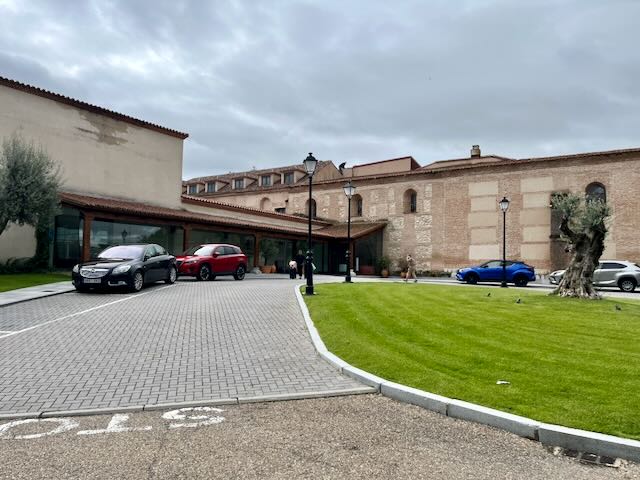
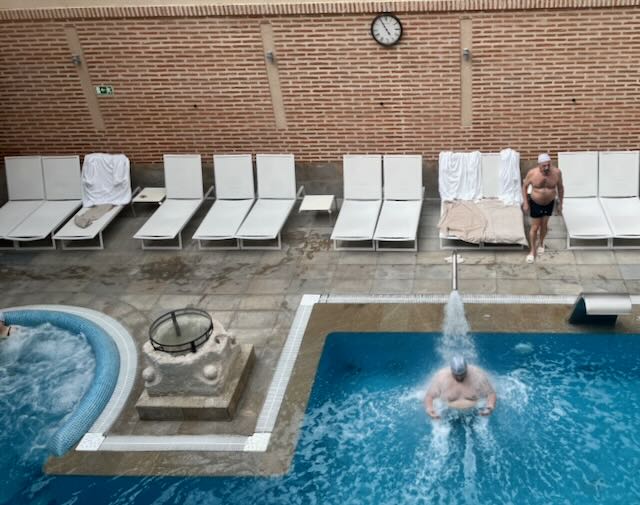
I saw no Americans or other non-Spanish, except for a group with Norwegian flags on their luggage. We were later to learn that the “spa” consisted of spring water heated by the hotel to bathtub temperatures. Visiting the heated pool cost an extra forty euro so we just looked at it from above and could see a guy lounging underneath a blast of hot water.
We booked two rooms, both very nice. As cyclists on a rainy day it was a huge relief to have dinner and drinks that evening in the hotel’s restaurant without having to go out. By American standards the whole experience was still quite affordable.
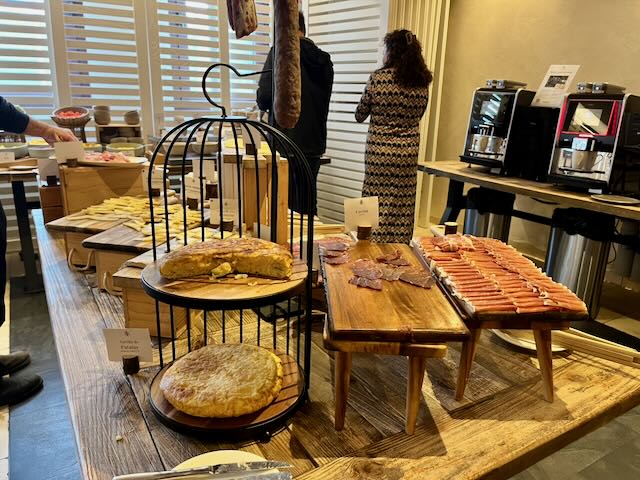
The Spanish generally eat a light breakfast, saving it up for their huge lunch at two or three in the afternoon. Nevertheless, the breakfast buffet at Castilla Termal Olmedo was one of the nicest I have ever seen, with various kinds of high end cheese and ham. Each type of bread or croissant tasted crisp and fresh, clearly baked that same morning. There was freshly squeezed orange juice.
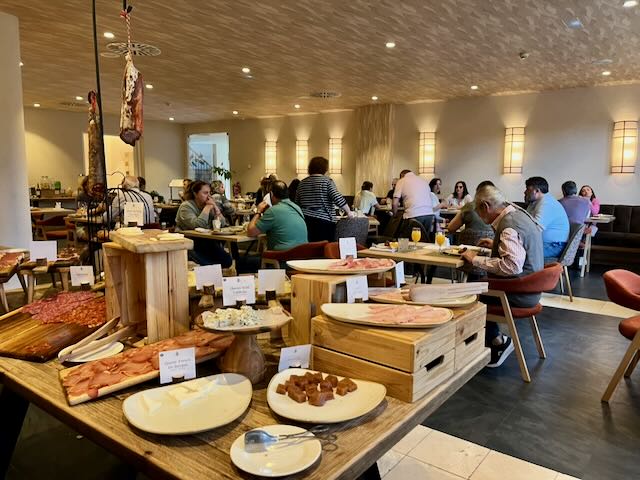
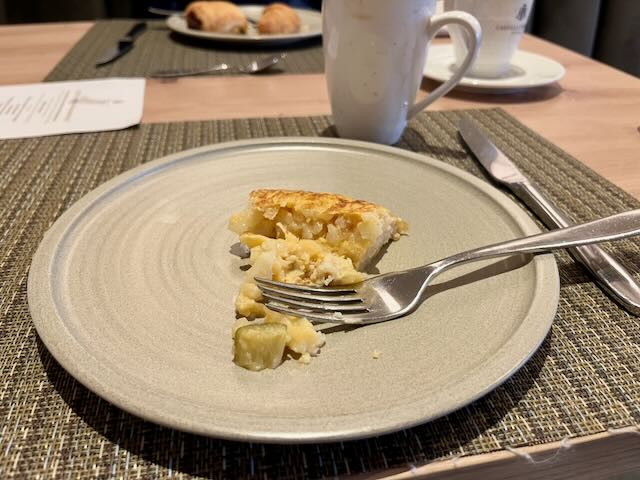
Spanish tortilla is delicious when at room temperature. Here you just cut yourself a slab. I came back for seconds. This one, rather unusually, included bits of zucchini and carrots.
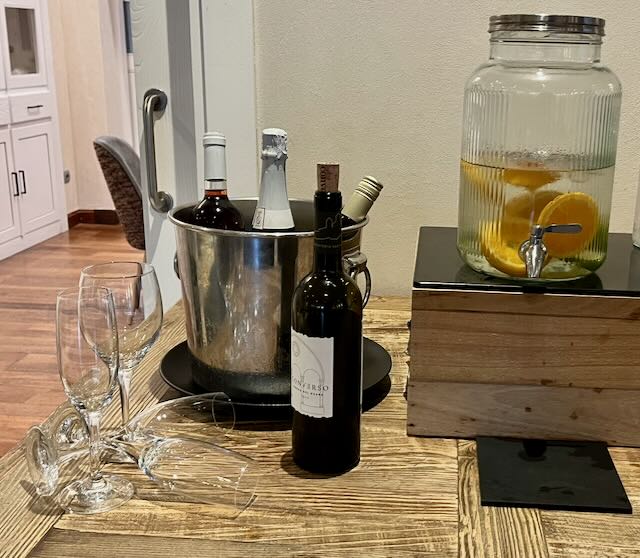
I didn’t see anyone drinking but they offer a breakfast glass of red wine. Take what you want.
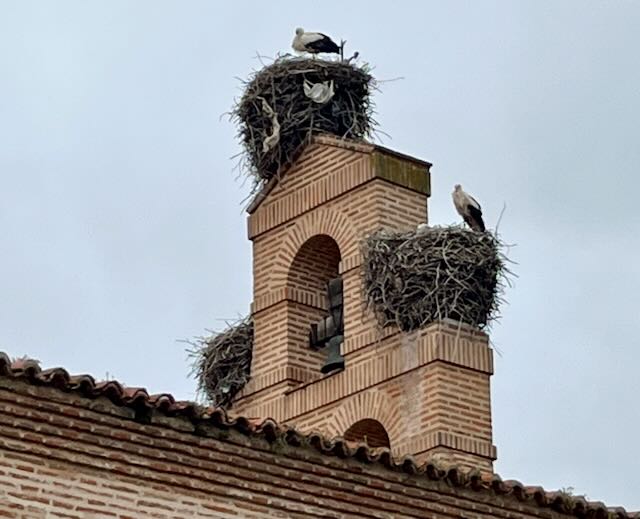
We prepped to cycle onward. The convent’s former steeple housed huge storks, the first of many we saw on this trip, usually nesting on church steeples or the peaks of other public buildings.
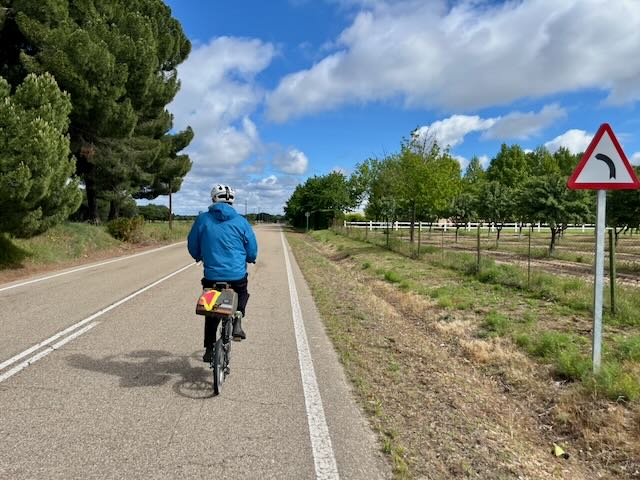
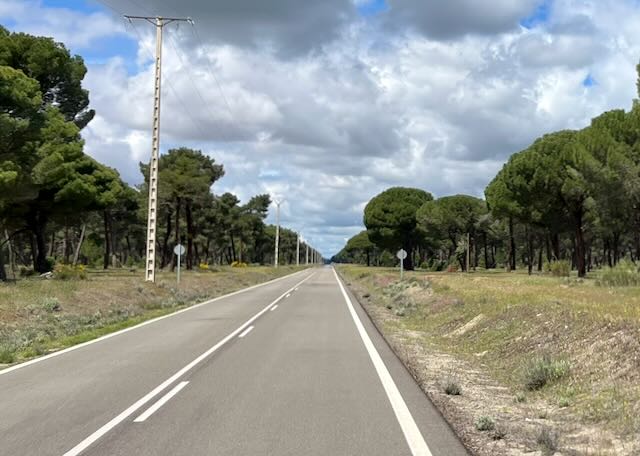
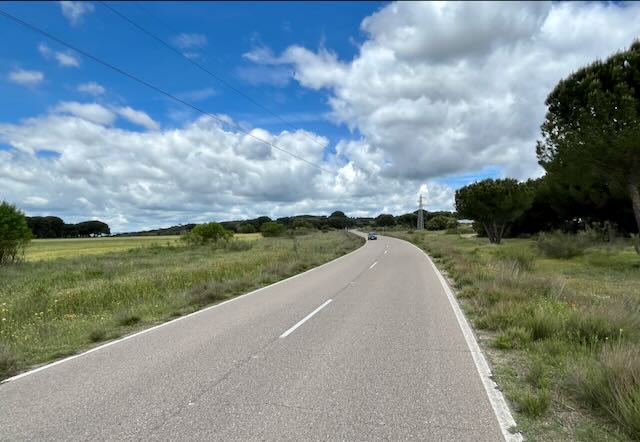
Our day’s destination would be the much larger city of Valladolid. We cycled on country roads with very little traffic.
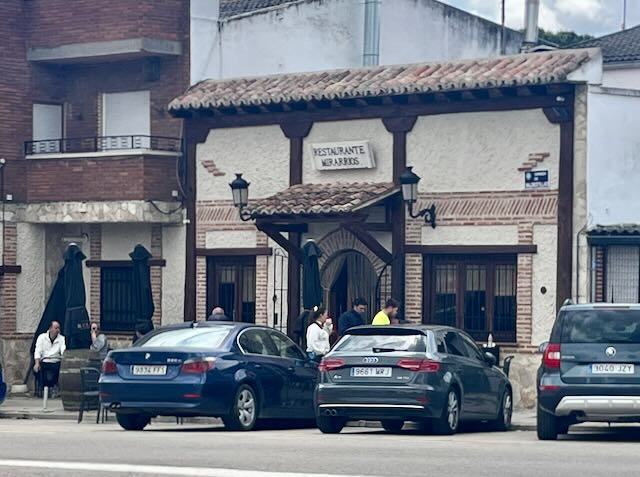
In the town of Puente Duero, just outside Valladolid, around two in the afternoon we stopped at a bar/restaurant called Mirarrios.
Inside, but still outside the dining room, the bar scene was lively.
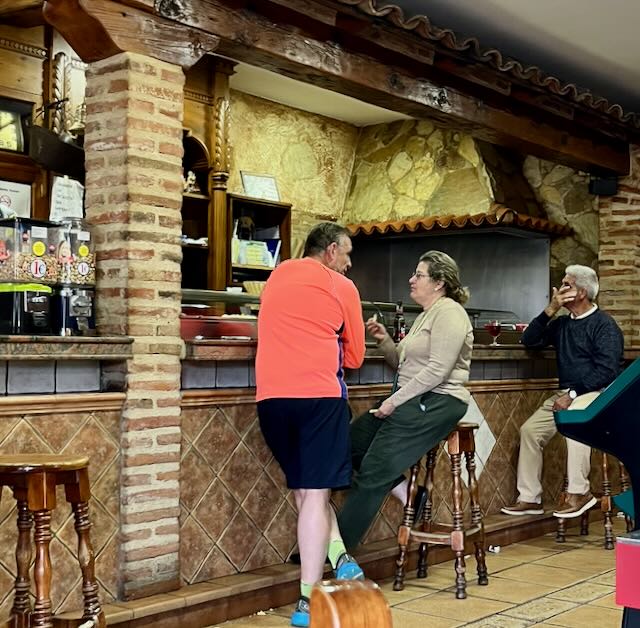
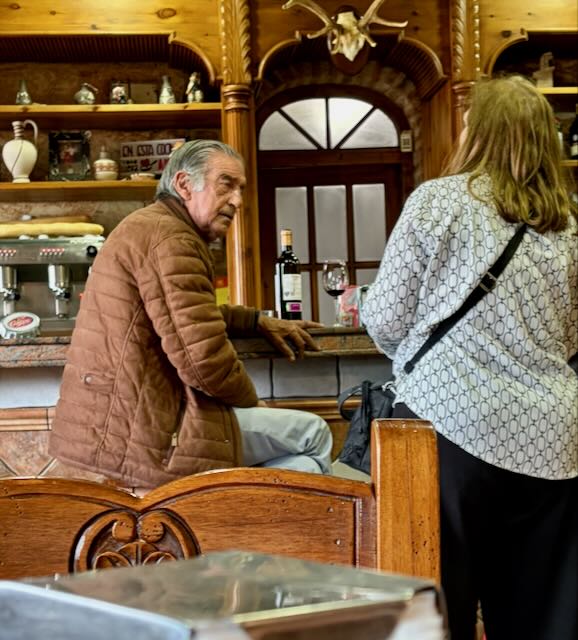
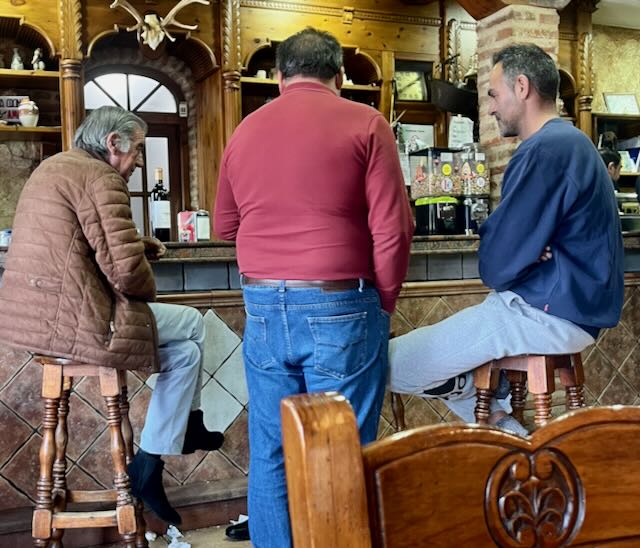
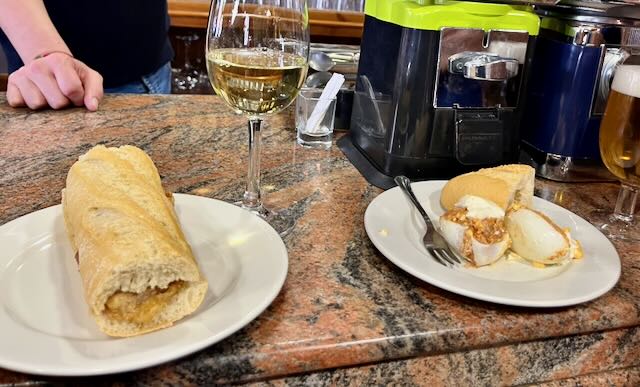
Everyone around the bar seemed to be eating as well as drinking so we skipped the nearly empty dining room and lunched on Spanish bar food. You can always tell great ingredients when just bread and meat taste wonderful, even when lacking the usual lettuce/tomato/mayonnaise. Tapas are easy because you just choose what looks good.
I chose a sandwich of pig’s ears and a glass of white wine. Those ears were bigger than the day before, just two filling the loaf when loaded lengthwise. It was delicious; like a bacon sandwich, although Lyman was again grossed out. He had a beer with two of what we would call deviled eggs, with bread.
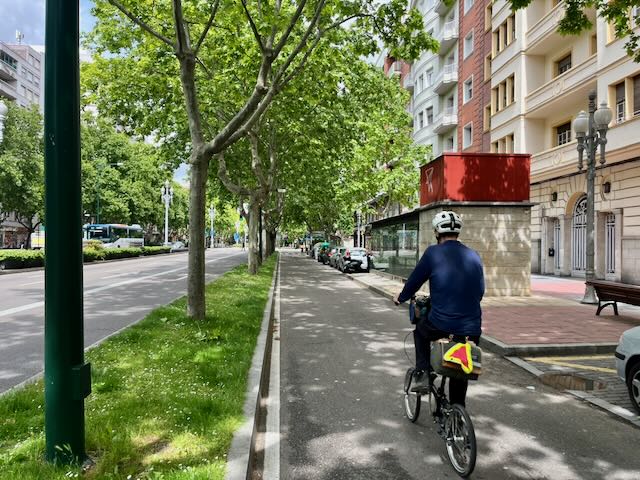
Cycling the last few miles into central Valladolid, population 300,000, felt like entering a really big city, one that I essentially had never heard of. We biked through miles and miles of likely 1970’s apartment blocks seemingly inspired by the urban planner Haussmann’s 1870’s vision of Paris.
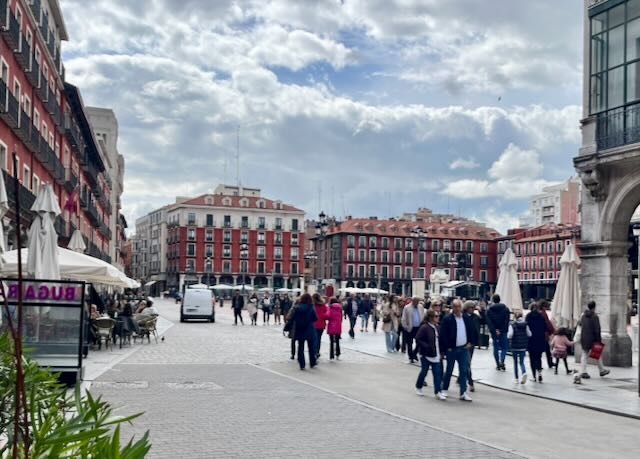
We finally reached the Plaza Mayor in the center of Valladolid. What American city of this size has such an impressive city center?
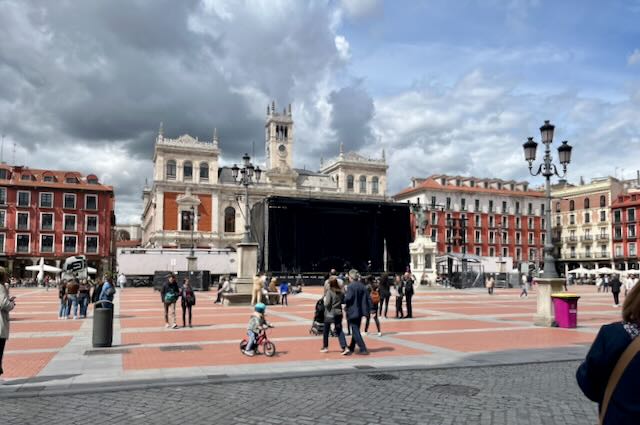
They were setting up a huge stage in that same Plaza Mayor but we had no idea for what and when and who.
We both got ice cream cones and searched my phone for a hotel. Just off the far corner of that same Plaza Mayor we found Hotel Imperial.
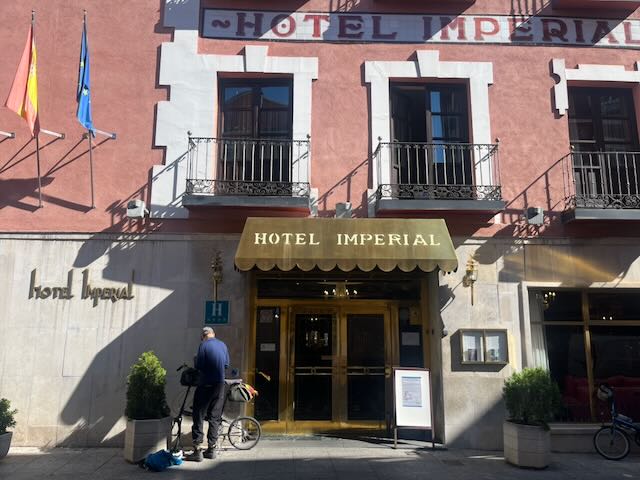
The Imperial had nice rooms but its special feature was an older desk clerk who loved offering advice about his favorite city, Valladolid.
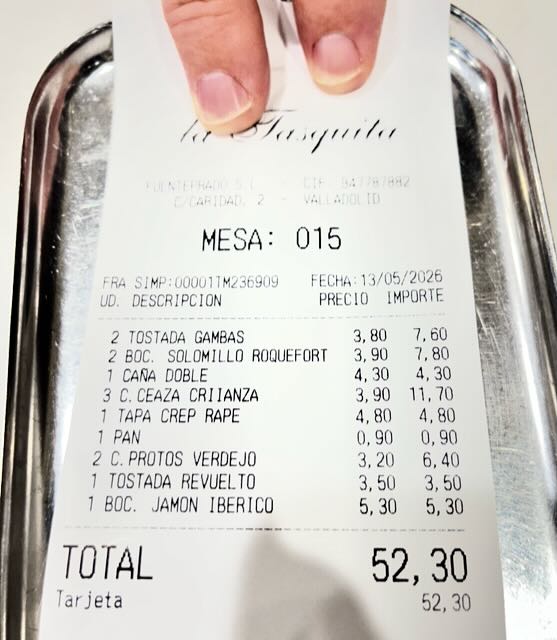
Top of his list was the nearby tapas bar La Tasquita. Nowhere else in Spain did we see people waiting in line for a restaurant, and the line to La Tasquita at 7:00 PM stretched down the block! We thought of giving up, but chatted with a few people who said it was worth it, and just joined the queue.
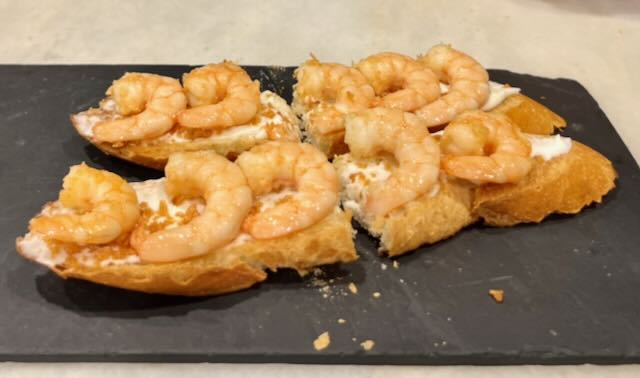
We really only had to wait about twenty minutes. Our waiter was older, professional, and deeply knowledgeable about their tapas menu. Our desk clerk friend had also given us specific recommendations. One order each of shrimp on toast.
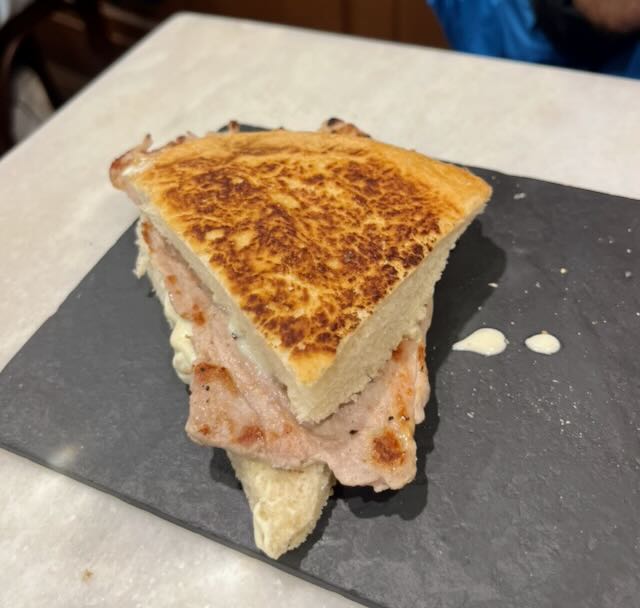
“Bocadillo de solomillo al Roquefort” (Little sandwich with beef tenderloin and Roquefort cheese.)
There were other tapas. We stayed more than an hour, and there was no pressure to hurry and leave. Great place.
Later on we stood and watched some of the free concert on the Plaza Mayor by the Spanish group Orquesta Panorama. Lotta flash; like a Broadway show version of a rock band.
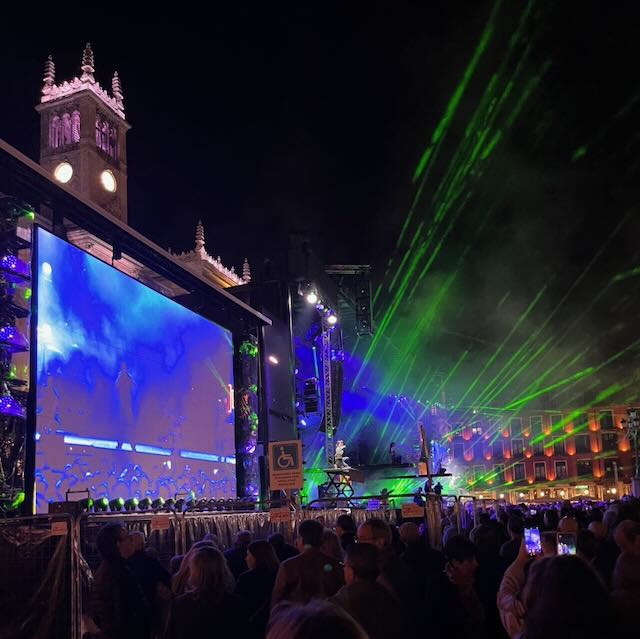
The next day we cycled through the city on our way downstream towards Palencia.
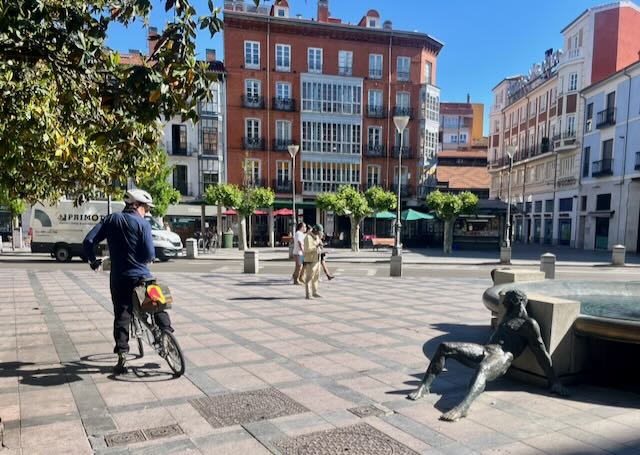
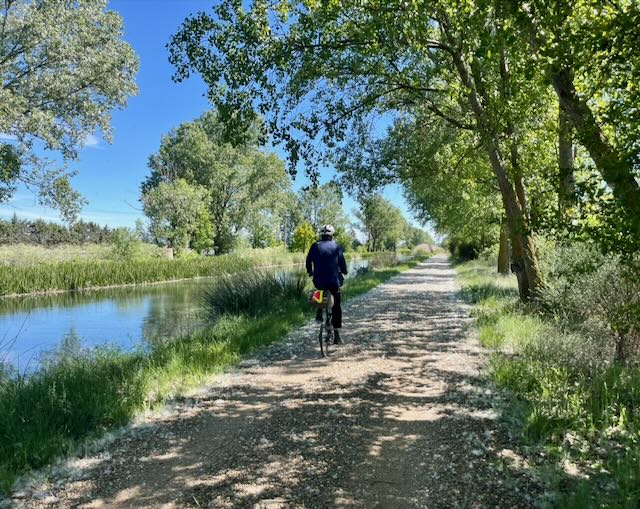
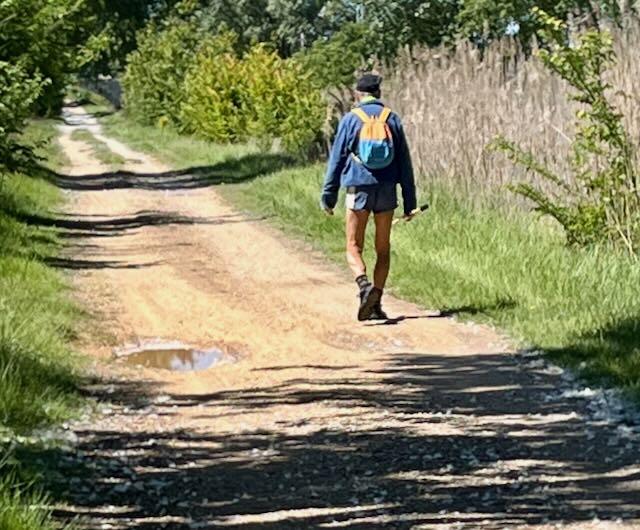
We could mostly cycle on bike paths along a canal; some better than others.
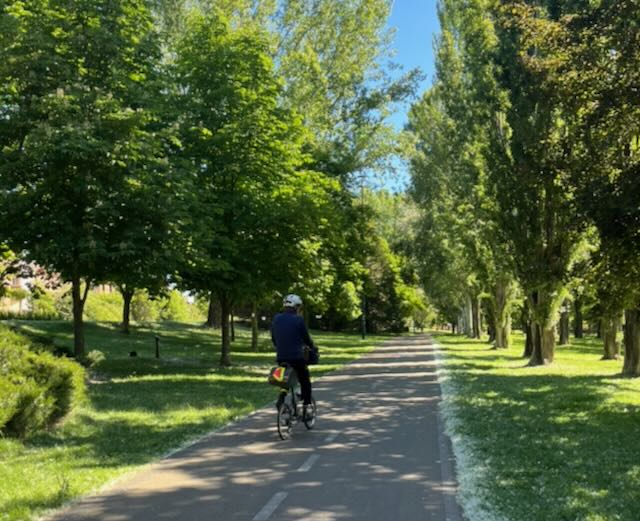
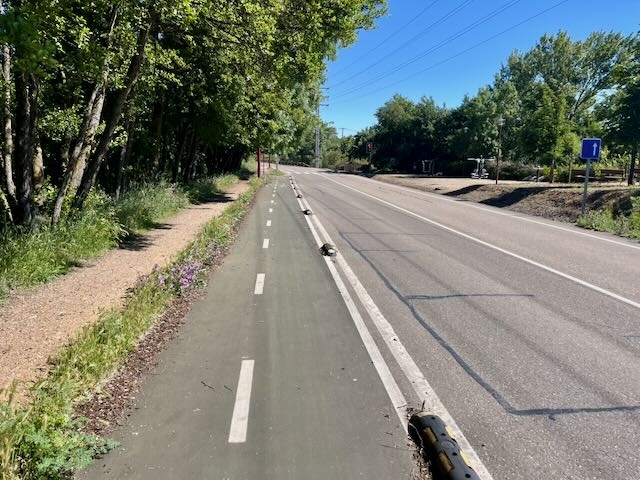
About 1:30 PM we rolled into the tiny town of Dueñas looking for lunch.
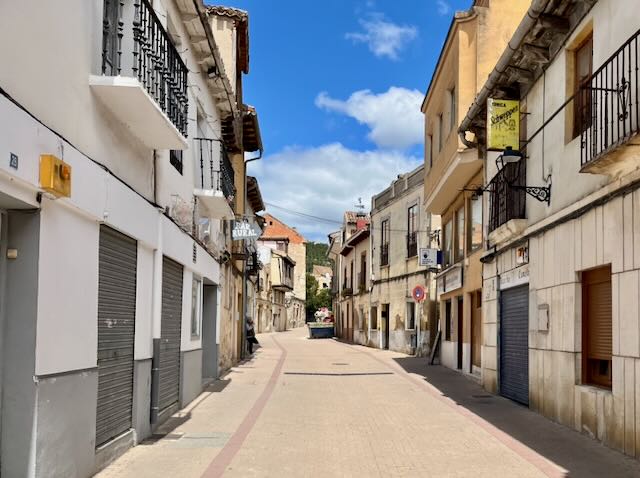
By searching “restaurant” on Google Maps I had found Restaurante Parrilla del Escudero. There was no sign.
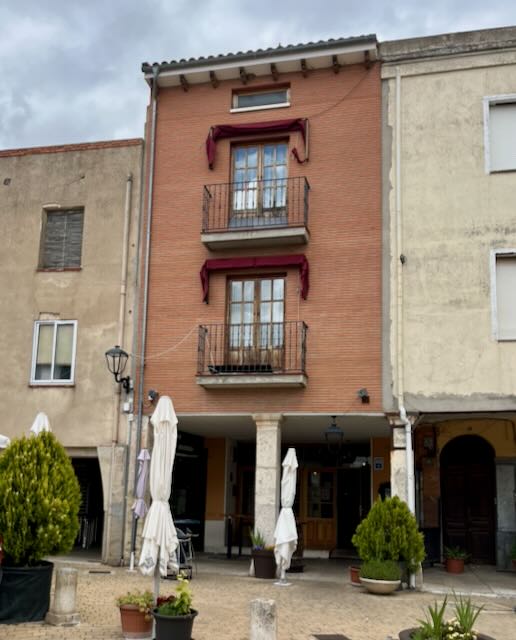
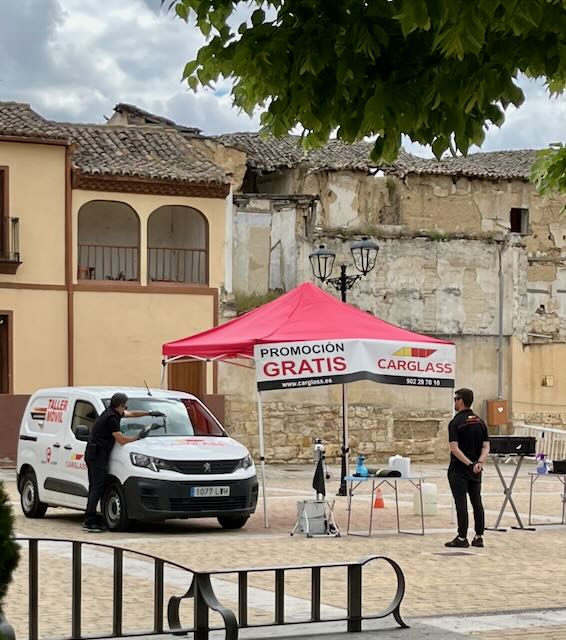
Across the street was a crew selling car window treatments.
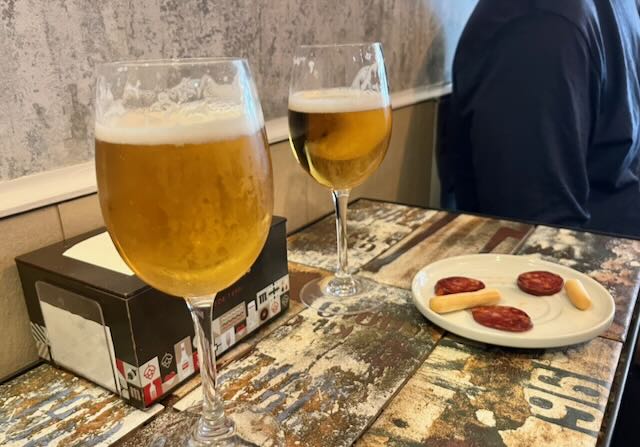
We had a beer on the ground floor bar waiting the twenty minutes before the upstairs dining room opened at 2:00 PM. They gave us freebee appetizers.
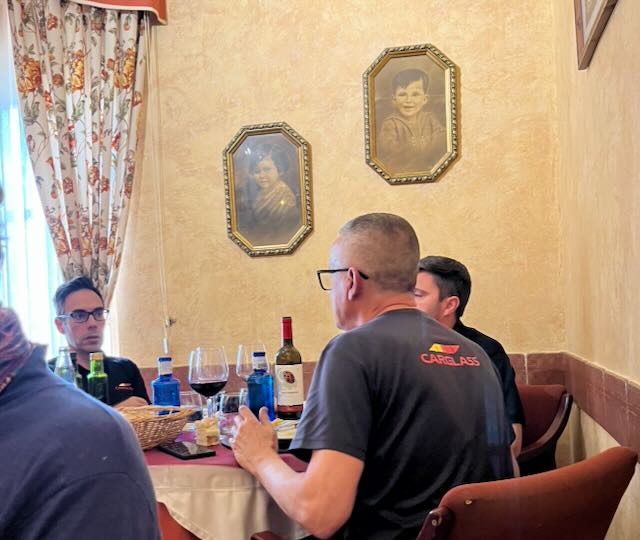
Once upstairs we were one of just three or four tables eating, including the CARGLASS guys.
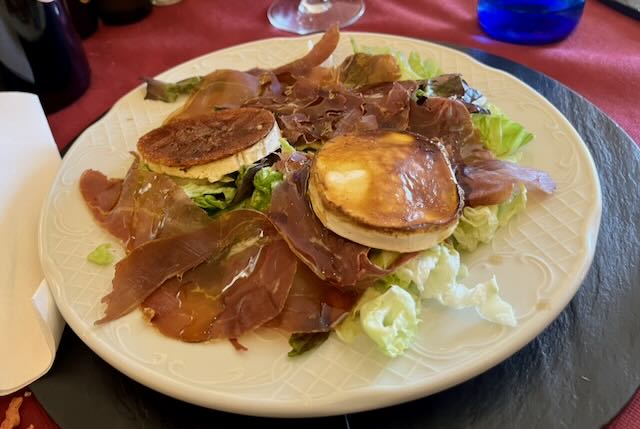
Lyman ordered bean soup with clams but I chose the three course lunch. First course was my favorite dish of this entire trip; “salad” which started with amazingly delicious plain lettuce and olive oil; how do they make it taste so good? On top of that were sheets of Prosciutto-like jamon, combined with two discs of fried mild cheese, all of this drizzled with more olive oil. The sum total was perfection.
On these trips, anywhere, really, my body innately tells me eating fatty red meat at every meal is just not good for me so I Iovingly wolfed down my second course of bacalao, previously salted cod, with a tomato sauce. And fries.
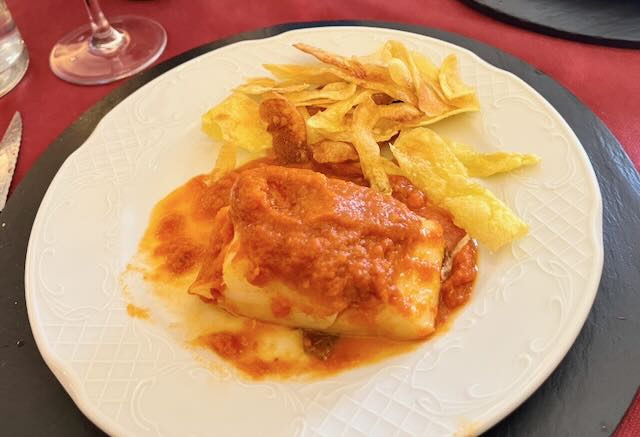
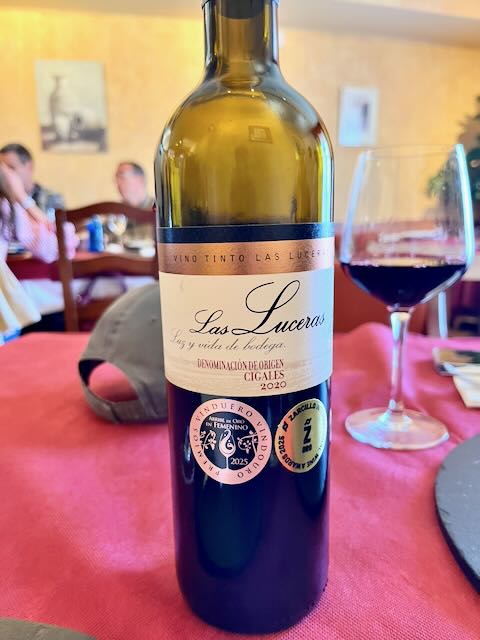
The two of us combined all this food with local red wine. We had asked for just a glass but they left the bottle there, their way of saying; just take what you want.
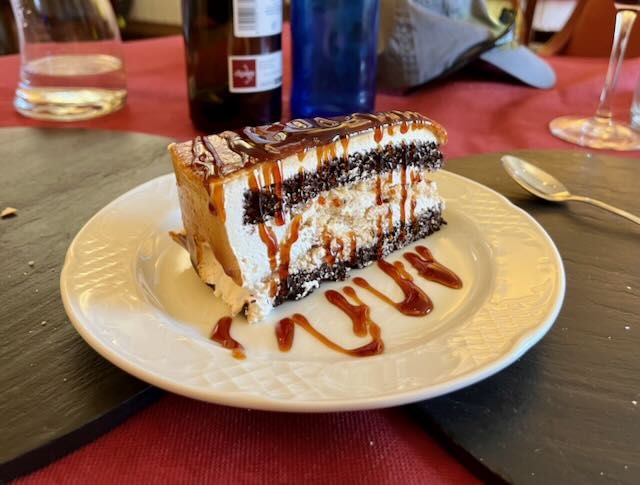
A dessert came with my meal but Lyman ate most of it. With it we had, of course, an espresso coffee each.
It was tough to get back on the bicycles after all that.
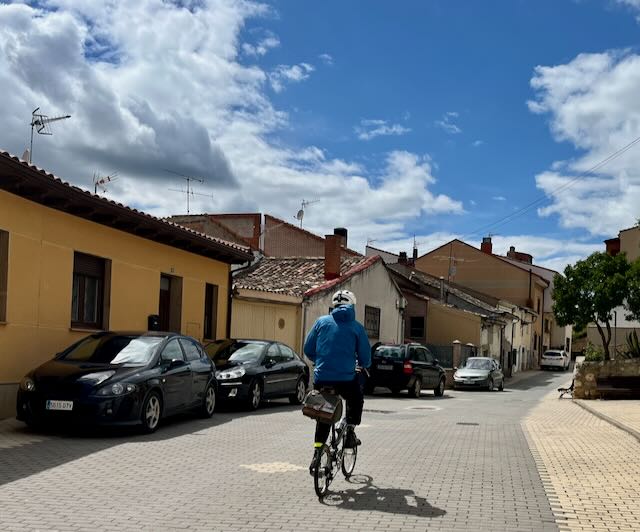
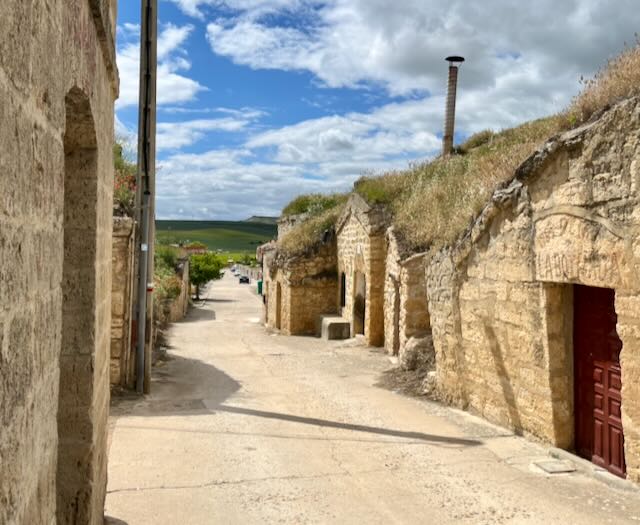
On the uphill outskirts of this town of Dueñas we were not sure what to make of this medieval looking neighborhood. Were these some kind of agricultural storage huts?
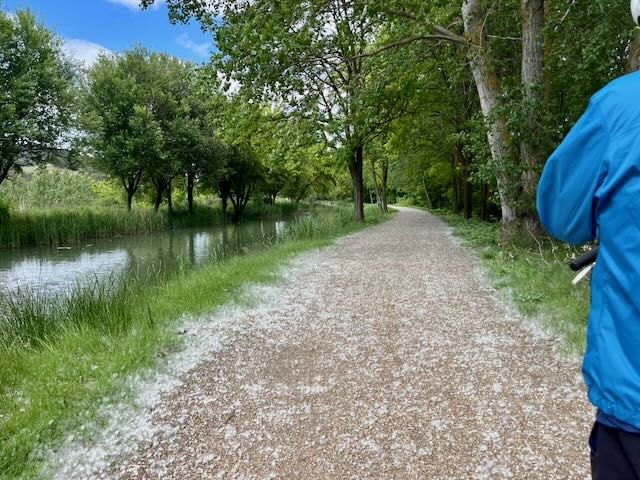
We still had fifteen miles or so to our day’s destination, the city of Palencia. Part of the way was again on a canal path, which was littered with “cotton” particles coming from the ubiquitous cottonwood trees.
Palencia is population 77,000. We cycled into the center and found two rooms at Hotel Castilla Vieja.
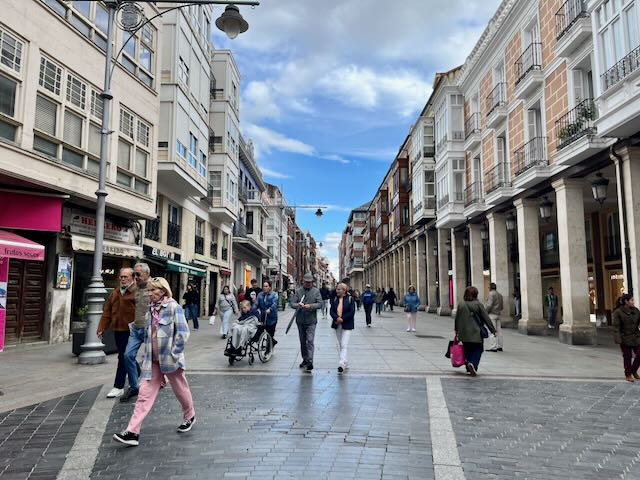
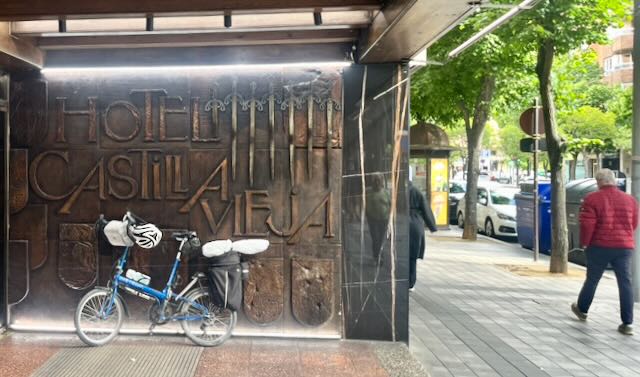
We walked around the city but the hotel bar had a nice atmosphere and genuinely delicious tapas.
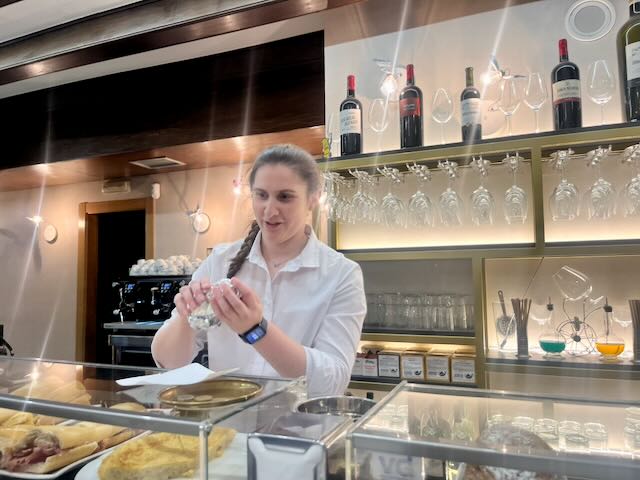
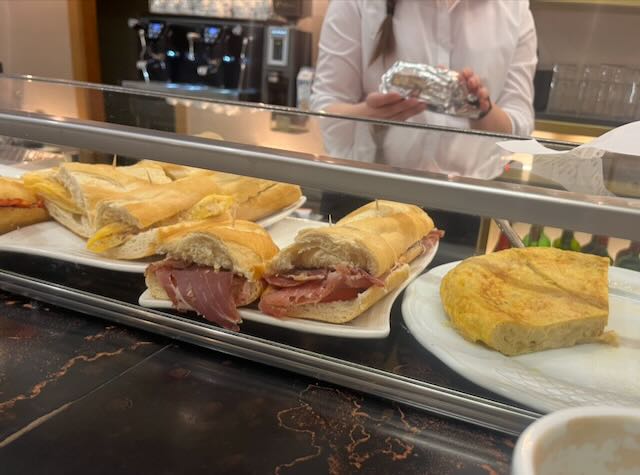
The next morning we came back and had them pack up two of these ham sandwiches “to go” for our bike ride out in the rural countryside. The bread was, of course, perfectly fresh and crisp.
We had two days left to cycle, and I plotted that we could reach the city of León in those two days. From there we could take a train back to Madrid. There were no major towns before León. Before leaving Palencia I booked over the phone for that evening a middle-of-nowhere rural hotel with restaurant.
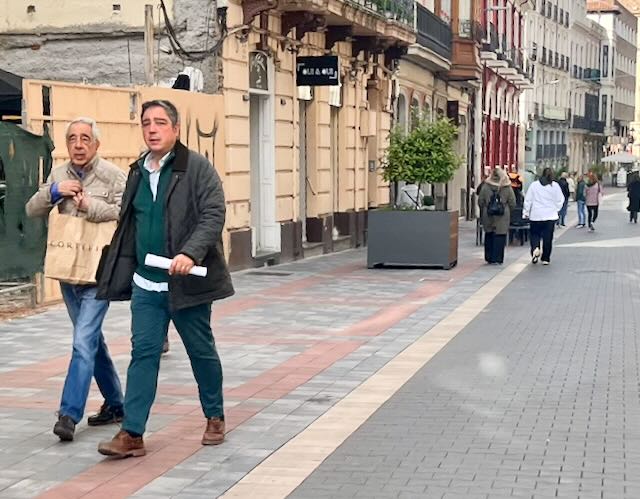
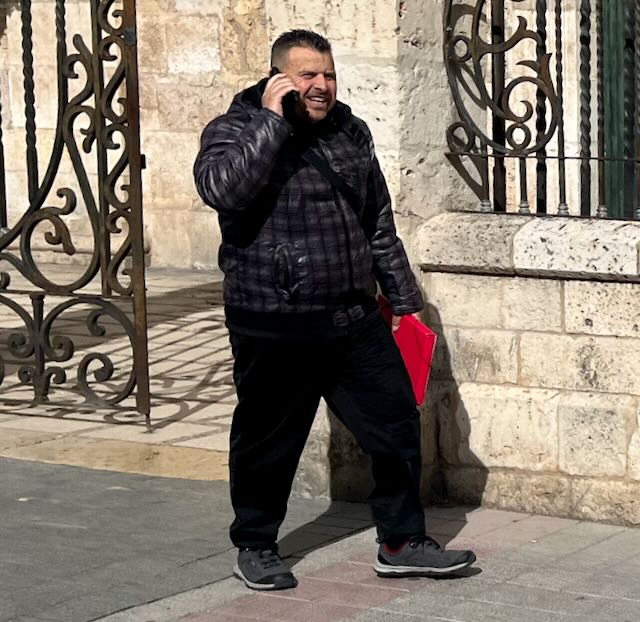
We cycled out through the streets of Palencia.
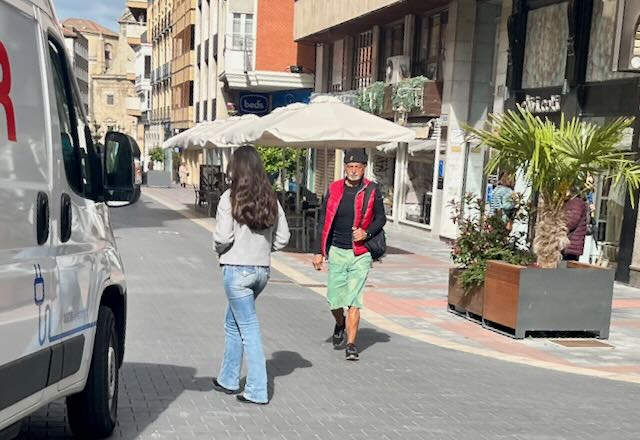
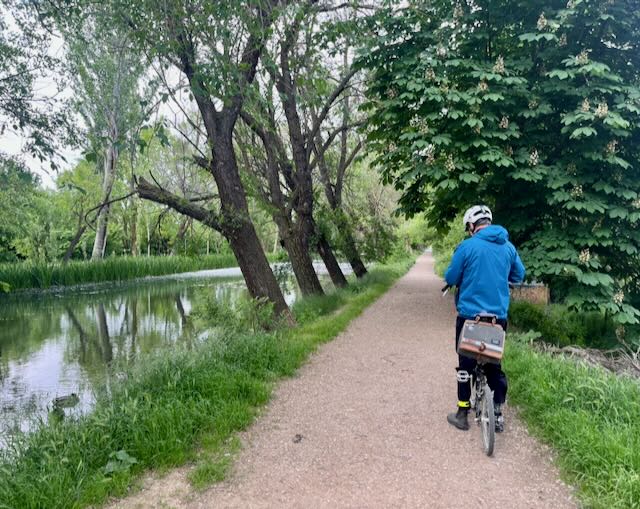
For short while we could cycle on a canal trail.
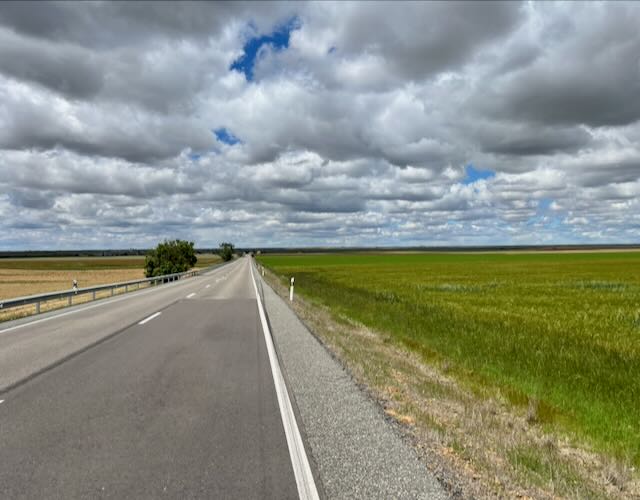
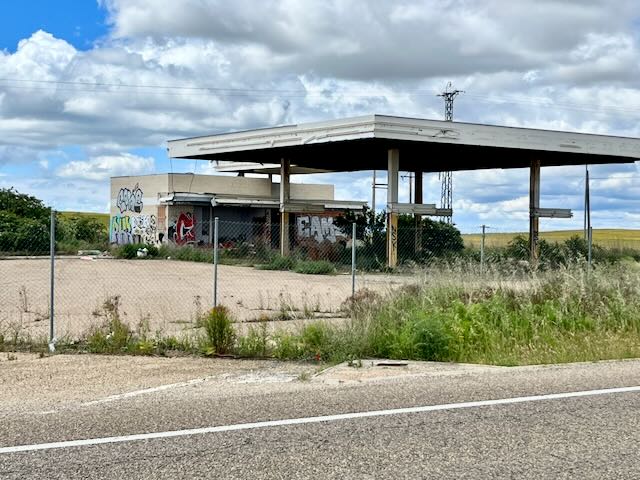
Eventually we were out on the nearly empty highway.
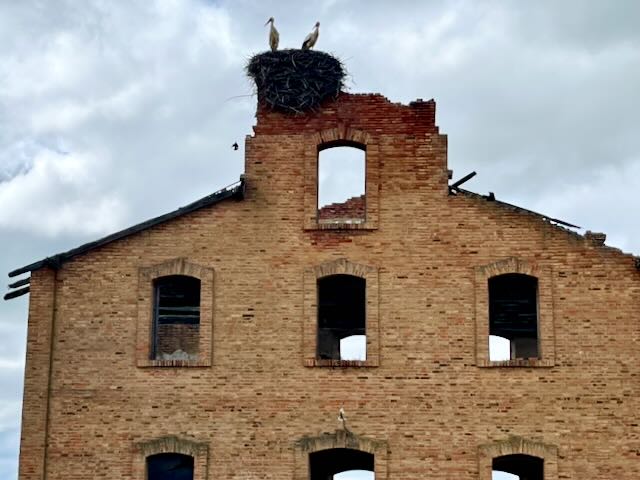
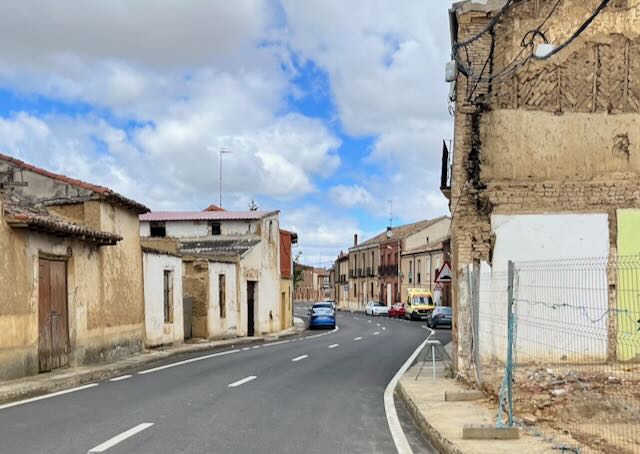
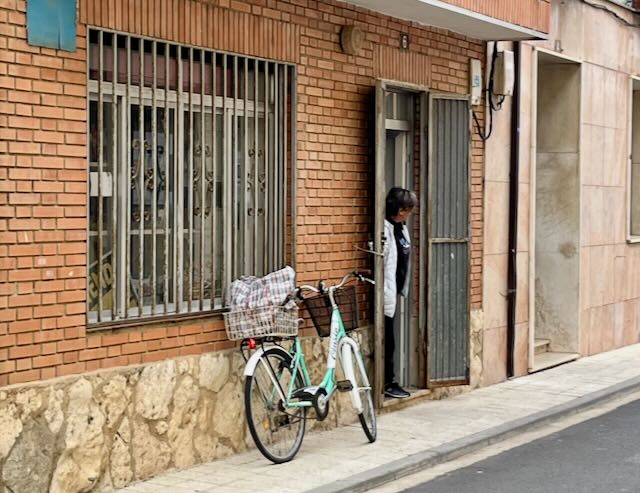
Occasionally we would pass through rural villages, most lacking any bars or stores, this one with a stork’s nest on an abandoned building.
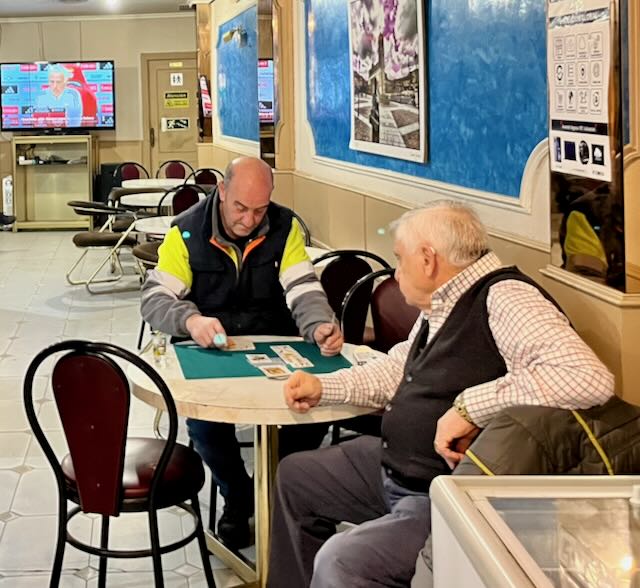
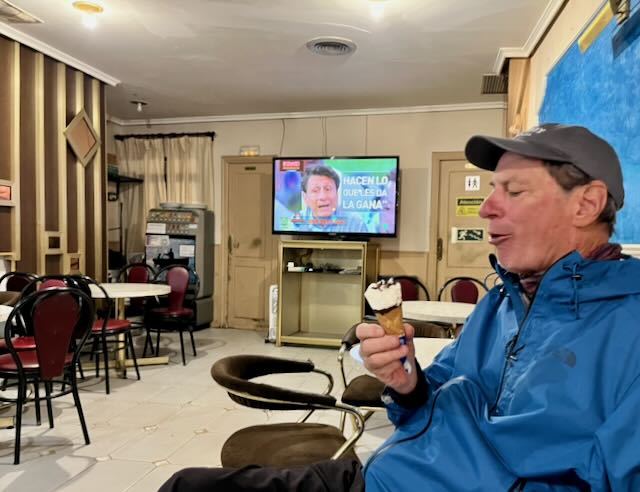
By mid-afternoon we wanted something cold and sweet. The town of Villalón de Campos didn’t have a store but did have a bar with a cooler of mini-mart type ice cream bars.
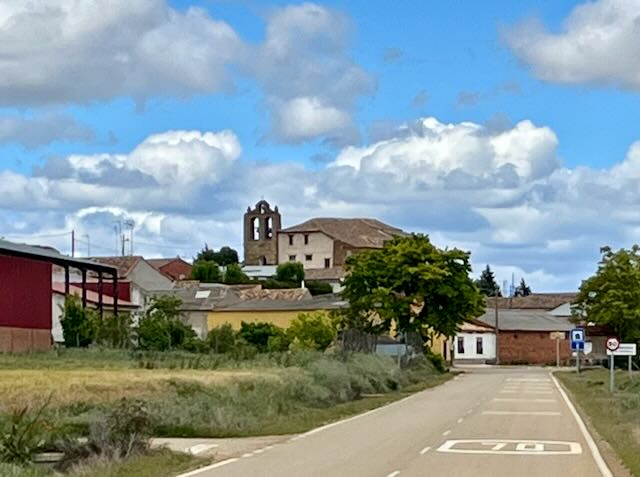
A few miles further was our day’s destination, the hotel I had located early that morning, Hotel Rural Rincón de Doña Inés. In Spain even rural hotels are usually in some kind of town. We biked up to a tiny village of which the hotel is the only commercial establishment.
The hotel had hardly a sign.
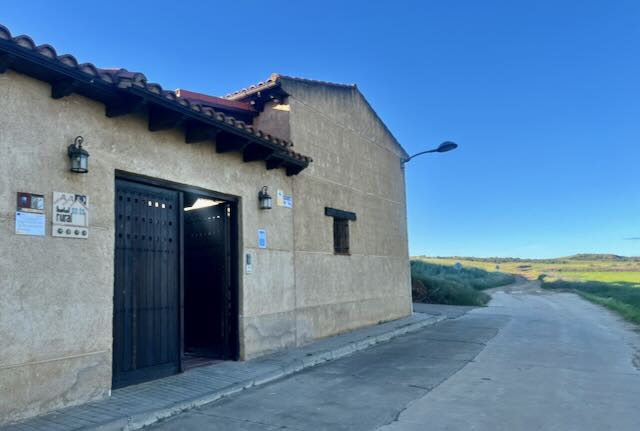
It is run by a family and has maybe fifteen rooms. A friendly young man checked us in. We saw no one else around. We asked if they had beer.
“Claro”
“Dos dobles, por favor”
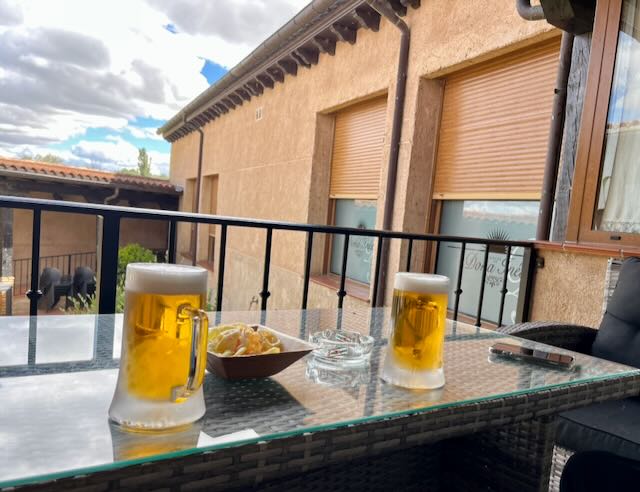
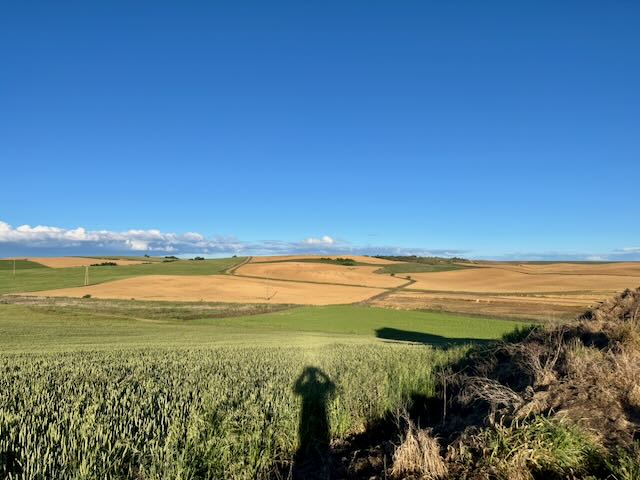
Later on, I took a brief walk around the village, just a few buildings cast on a hillside.
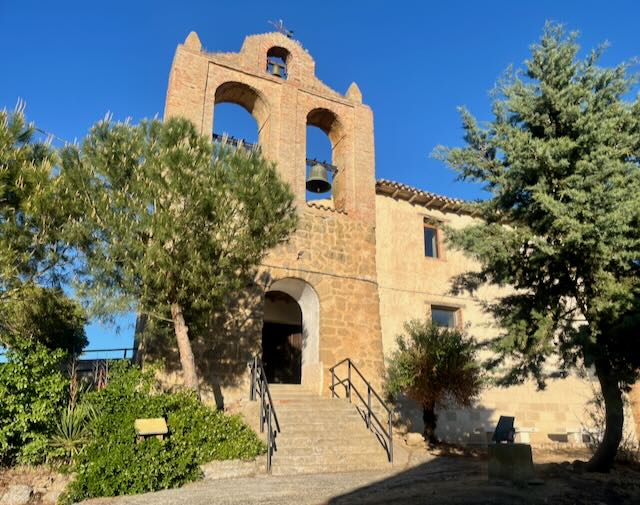
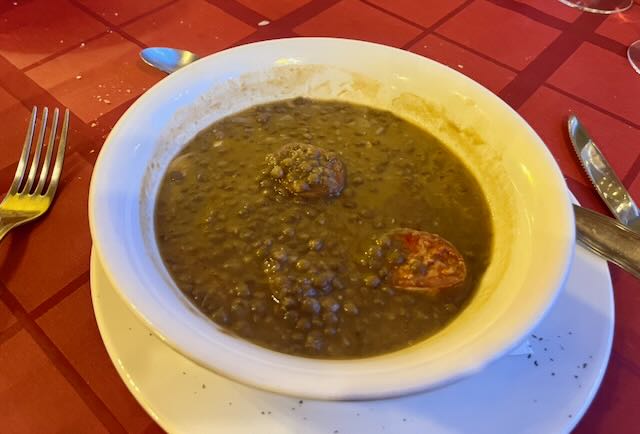
Even in Spain it is rare to find a middle-of-nowhere affordable hotel with an in-house nice but not super fancy restaurant. At dinner my first course was lentil soup with chorizo.
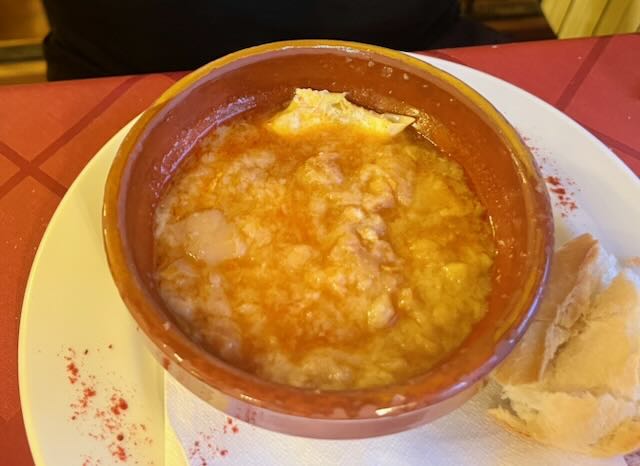
Lyman had sopa castellana, traditionally made with stale bread.
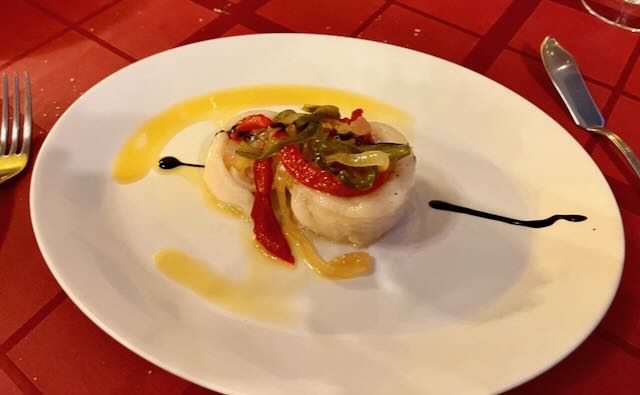
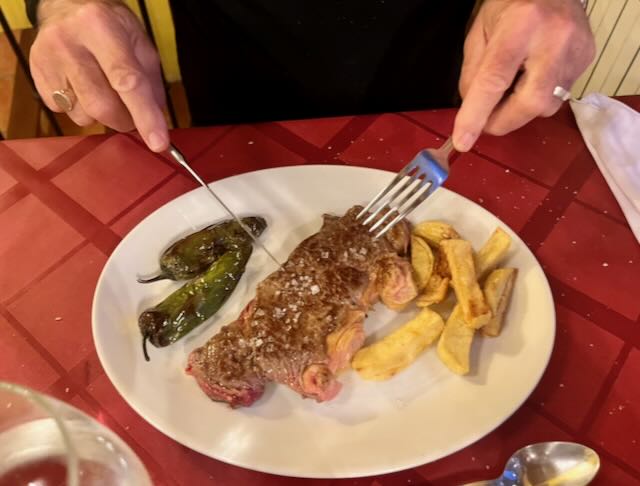
For the main course I had fish, Lyman steak.
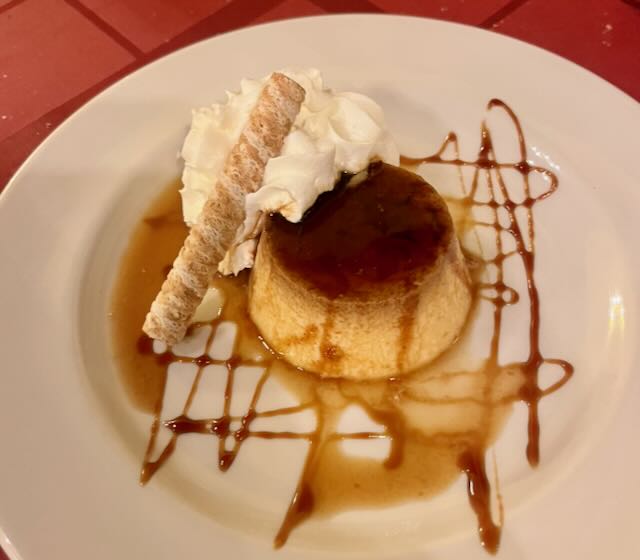
For dessert, me flan, Lyman: cheesecake.
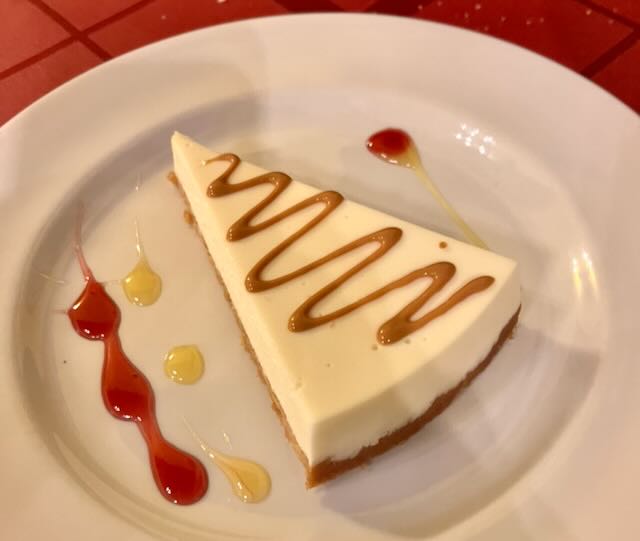
Great meal.
The next morning we had one full day of cycling left. Our plan had been to continue on to León but I was having second thoughts. The long ride to León would be against a strong wind and partially on busier highways. Why not just go with the wind and cycle back to Palencia, but on a different route?
We headed out in lovely weather. There is nothing in cycling more pleasurable than a tailwind.
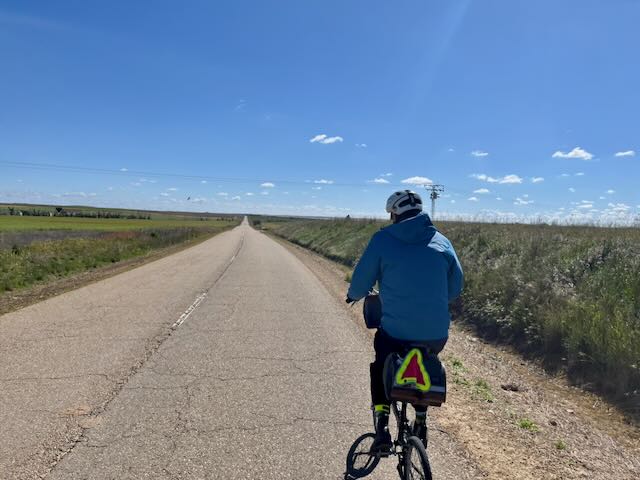
For quite a while a car would pass us only every few minutes. I seemed like a good time to stop and sing something. This video is only thirty-five seconds. I had never taken this song seriously until I heard it covered a few months ago by the up-and-coming New Orleans soul singer Anjelika “Jelly” Joseph. We had no idea a random bicyclist would appear.
We passed through several small towns each not large enough to have a store or bar. We ultimately found café con leche in a village called Frechilla. Note they use real china cups and saucers.
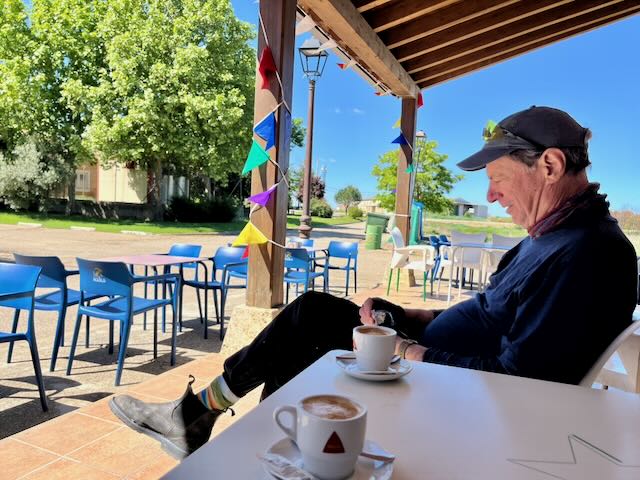
We had a nice extended lunch in a town called Paredes de Nava before arriving late that afternoon back in Palencia. Hotel rooms had gotten scarce and we had to stay a few blocks from the historic center in a combination gas station and motel.
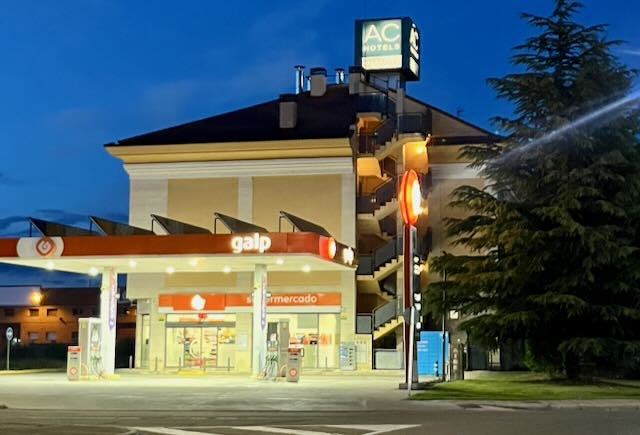
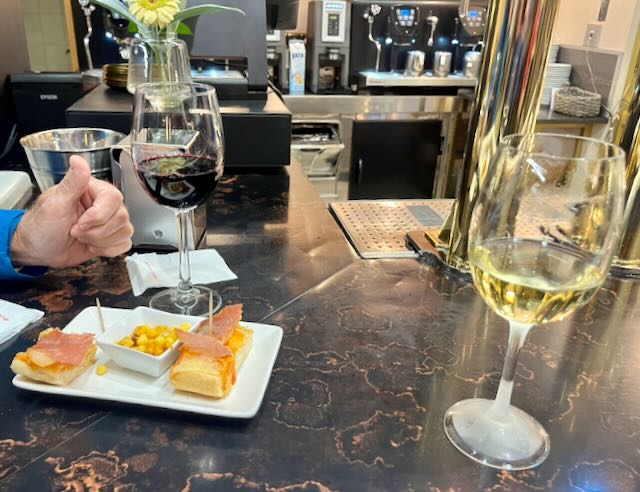
The hotel was actually quite nice and was only a ten minute walk from the tapas bar of our previous hotel. Europe is so affordable now; at a nice hotel bar in Palencia these two glasses of wine WITH the delicious little sandwiches and freebie snack nuts the total was only Euro 5.50; or US$6.40.
We took the train the next morning back to Madrid.
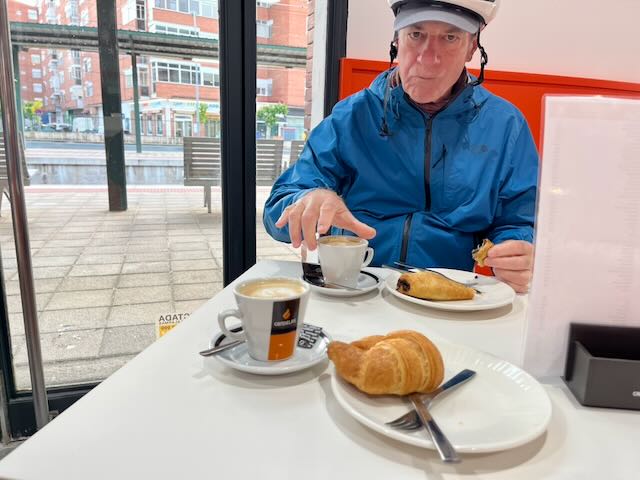
Breakfast in this small city train station was civilized, genuinely fresh croissants on actual plates with café con leche in real cups and saucers.
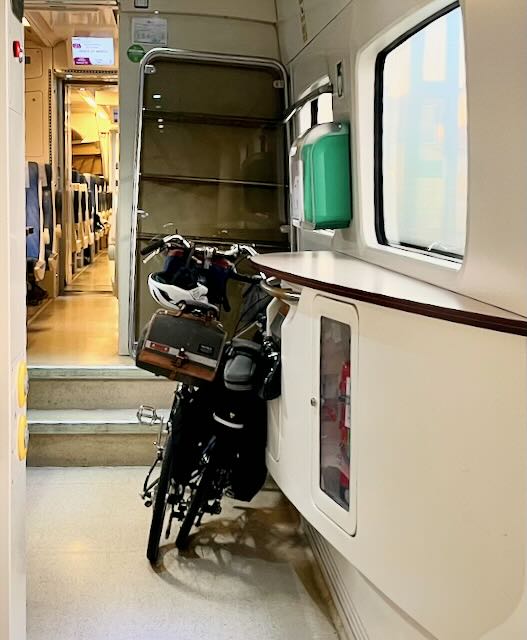
Time was not of the essence so instead of the hour and a half “high speed” rail we took the nearly four hour “conventional” train because it did not require us to disassemble the folding Bike Fridays or to very uncomfortably haul the packaged bicycle down a train platform. On the slower one we could just roll the bikes onto the train.
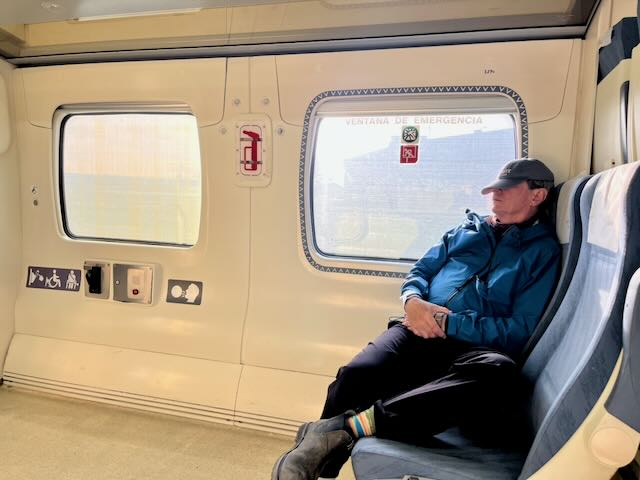
Lyman always seems to find places to sleep.
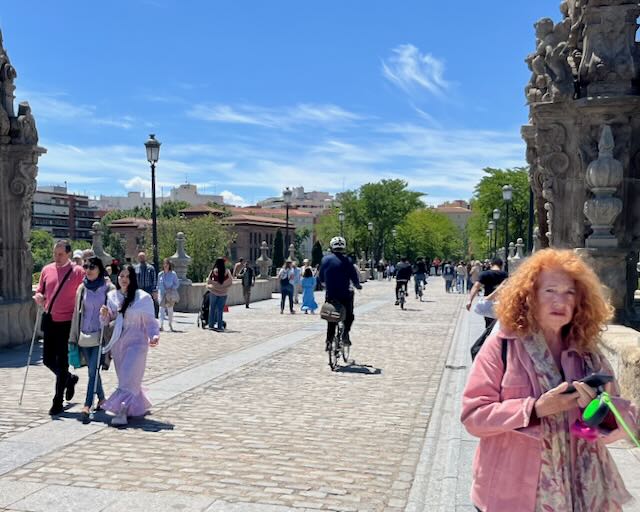
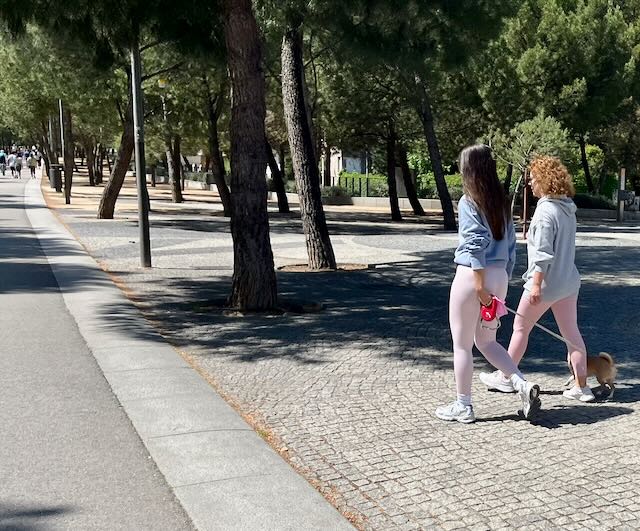
On arrival we cycled across about six miles of central Madrid from the Príncipe Pío train station to our hotel in the Retiro neighborhood, much of it on a bike / pedestrian path along Rio Manzanares.
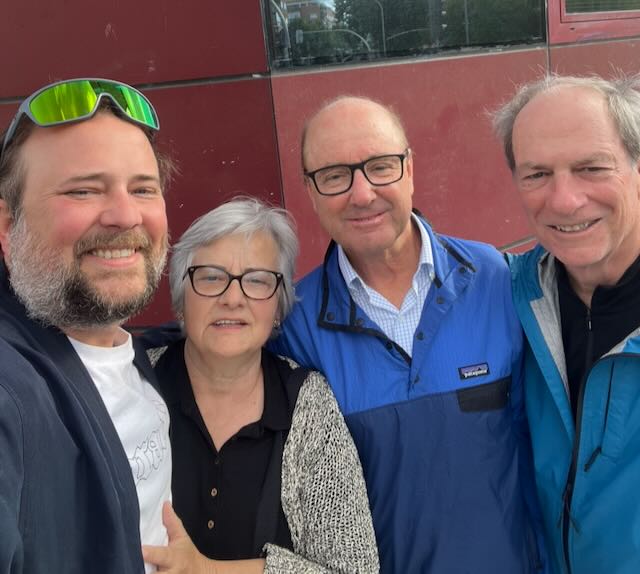
Late that afternoon we met lifelong friends Esther and her son Miguel for drinks at the bar of the hotel.
Hotels in Europe dislike guests bringing bicycles up into the rooms. We really wanted to do the process of breaking down our bicycles into the hard suitcases up there, so at this hotel we had to wait until the front desk was not looking to sneak a bicycle into the elevator.
We both flew back to America the next day.


Leave a Reply