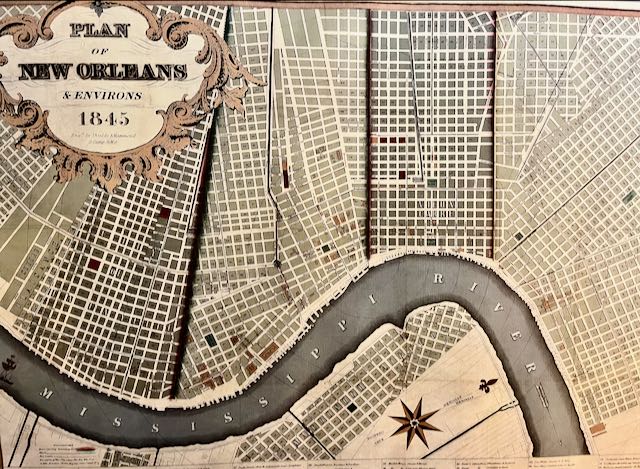
The entire time I have lived in New Orleans, both back in the 1980’s and also recently, I had snobbily dismissed almost everything that lay “across the river” despite the fact hundreds of thousands live Over There. The Mississippi River in New Orleans is wide and threateningly deep with a strong current. It seems the wild beast. No one pleasure boats here on the Mississippi. While most of New Orleans has always been on the East Bank, from very early on there were neighborhoods on the West Bank. (Because the curvature of the river the West Bank is frequently not to the west!) West Bank neighborhoods developed in conjunction with ferry services. We have an 1845 map of New Orleans on our living room wall. The West Bank neighborhood of Algiers sits opposite the French Quarter. Gretna is opposite Jackson Avenue in New Orleans, the site of a ferry for many years. On the 1845 map below, Gretna (although not then called Gretna) is the tiny dark rectangle under the river on the bottom left; Algiers is the area under the river but to the right.
On Saturday morning December 30 I found myself with a situation where I needed to go to the West Bank.
Background: Tootie and I purchased a second home in New Orleans almost three years ago. New Orleans is a city where we had lived as young lovers in the 1980’s. We now spend part of each year here. We have made some great new friends, two of whom invited us to their house in the close-in suburb of Old Metairie for a New Year’s Eve dinner and party. ”What can we bring? ” Tootie asked. I volunteered cooked greens or some other vegetable dish.
I am not at all certain one can taste the difference between local broccoli or kale or mustard greens and those grown on giant farms in California. Eating and preparing food is a creative experience where I obsess on tiny details. This minutia matters sometimes only to me. God notices. In New Orleans I am still learning where to find quality local vegetables. I have been biking regularly to the Crescent City Farmer’s Market, the largest of which takes place on Thursday afternoons in Mid-City.
For the dish to bring to the party on a Sunday evening I wanted fresh vegetables. I was misinformed there was to be no Sunday market in City Park. On Saturday morning December 30 I needed to find local vegetables. Such vegetables might be available at a market in Gretna, on the West Bank.
It is not just pride that drives Tootie and me to try and live in our small condo in the Upper Garden District without driving a car for days or even weeks at a time. Such a life really is less stressful. Each time I take the car out for a short trip I get stressed. On a bicycle one can do what one wants. It feels like freedom! Nevertheless on that Saturday morning I copped out. The Gretna LA Farmers Market opened at 8:30 AM. The good vegetables would sell out quickly. I could bicycle the mile and a half to the foot of Canal Street, take the ferry across, then cycle the delightful levee bike path just three miles along the river to Old Gretna and the farmer’s market. I did not do that. I surrendered and drove the car. It was cold outside and I wanted to get this done quickly.
Huey Long himself had directed the building of the first New Orleans area Mississippi bridge, which opened in 1935. Huey ordered the construction of the self-titled Huey Long Bridge not in New Orleans but twelve miles upstream, supposedly because he so disliked the upper classes of New Orleans. It was not until 1957 that another bridge, the now titled Crescent City Connection, opened in downtown New Orleans.
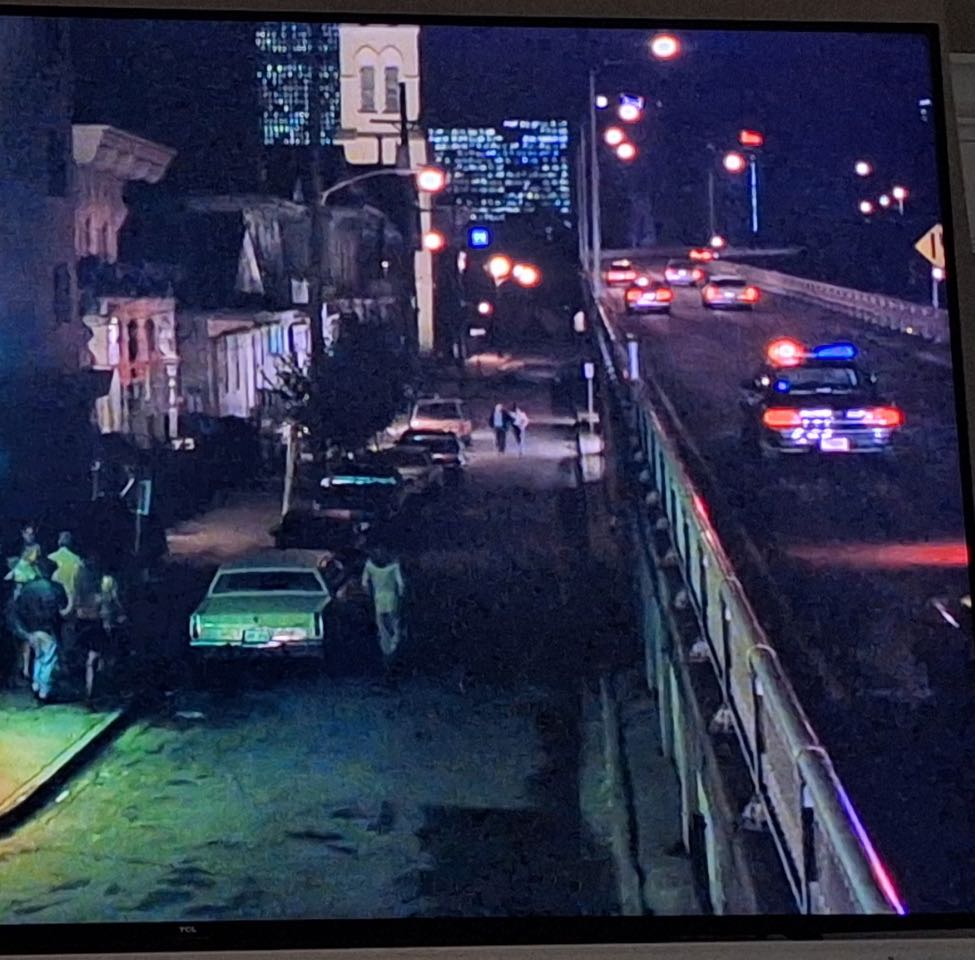
Our current condo is only about eight blocks from that newer bridge. From 1957 until 1992 there was a ramp for that bridge that extended up Camp Street into our neighborhood, starting at the foot of the then-neglected Coliseum Square Park. During the crack epidemic of the 1980’s drug dealers hanging around the park could escape by driving quickly onto the bridge. Trucks hauling shipping containers backed up into the neighborhood.
I am a follower of the national movement to tear down certain freeways built in the 1950’s and 60’s through central cities, most often in poor neighborhoods of color. I-10 still sitting on top of north Claiborne Avenue in New Orleans has always been part of that discussion. A mile away our neighborhood the Lower Garden District was not historically all that poor, so maybe that is why it successfully convinced the Powers-That-Be that in 1992 this ramp should be removed. It was done in conjunction with the construction of a new ramp three blocks away on Tchoupitoulas Street, making for easier container deliveries to the Port of New Orleans. Our neighborhood’s success may have been because transportation planners seem to care more about truck traffic than making a neighborhood more livable. Here is a photo I found on Facebook of that pre-1992 ramp in my neighborhood on Camp Street. looking downtown.
Here is my photo of that exact spot without the ramp, thirty years later in 2023.

Freeways sell a false promise because they work so well when there is no traffic. The Crescent City Connection bridge has gridlocked traffic nearly all the time. Leaving home by car at 8:15 on a Saturday morning I was lucky. The journey was amazingly fast. The bridge ramp torn down in 1992 has been replaced by an ingenious loop-de-loop; two U-turns that guide your car under the bridge, then up a steep ramp also underneath. Old Gretna is then just a few blocks away. My car drive there was astonishingly fast.

If I had been on a bicycle, I would not have had to worry about parking. I could have locked the bicycle just anywhere. Amazingly, arriving by car to the inner city Gretna market on this Saturday morning, on-street parking half a block away was painless at 8:29 AM.
There were about twenty small vendors at the market. Most were selling various homemade goods but not vegetables. Only two or three had farm produce, and much of that was local oranges. I have shopped at farmer’s markets for years and have learned to spot the difference between seller grown local produce and Costco stuff being resold. One guy had enticing looking broccoli florets. He had already removed the marginally useful thick stems. I jokingly asked him if they were grown on the West Bank. He said yes, they were grown in Marrero! He charged three dollars a pound. I bought about half of what he had and it was still less than a pound. I gave him three dollars anyway. He also had elephant kale, which was three dollars a bunch. I took some of that as well. Sadly, no one at the market had mustard greens.
At that other farmer’s market back in Mid-City New Orleans on Thursday afternoons the prices are really high, even compared to those at the even more elitist Carrboro Farmer’s Market near where I live in North Carolina. At the Gretna LA Farmer’s Market on the Westbank on Saturday morning the selection was awful but the prices were about half of what was charged on Thursdays six miles away in New Orleans. I felt sorry for the guy in Gretna. It was 8:30 AM and he had just opened his stand. If I had bought every broccoli floret he would have earned only five or ten dollars. I could sense a cultural difference; Gretna did feel like another planet from my New Orleans neighborhood. Gretna felt less cosmopolitan with fewer people from Somewhere Else. Most spoke with a pronounced New Orleans accent.
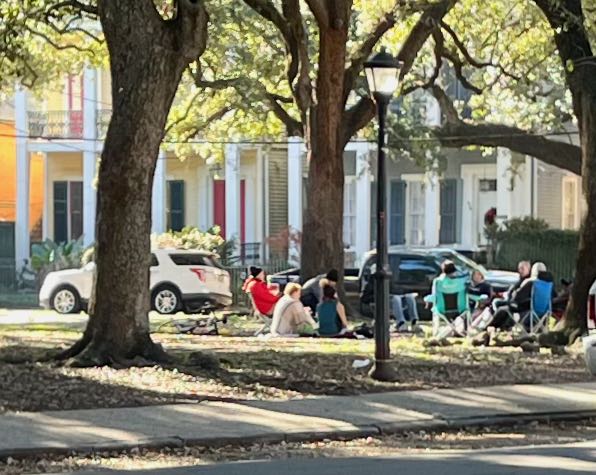
Walking out I passed a vendor selling freshly fried pork SKINS and fried pork RINDS. I had not even known there was a difference. I bought a $6.50 bag of pork skins then walked the thirty seconds over to my car. Again with almost no traffic I drove back home over the bridge. Driving into my lovely East Bank neighborhood I passed the now idyllic Coliseum Square Park. A Saturday morning AA meeting was being taken outdoors. I see it every week. During COVID many changes were made and sometimes these changes have stuck. People found they really liked doing things outside.
The entire car run to the Gretna LA Farmer’s Market had taken only thirty-nine minutes.
I surveyed my shopping results.
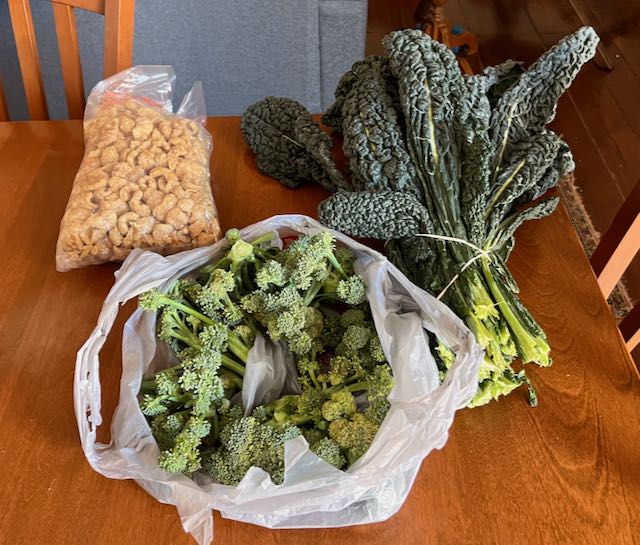
The New Year’s Eve party in Old Metairie the next evening was fabulous. I think I did a pretty good job cooking roasted broccoli and salted kale chips.
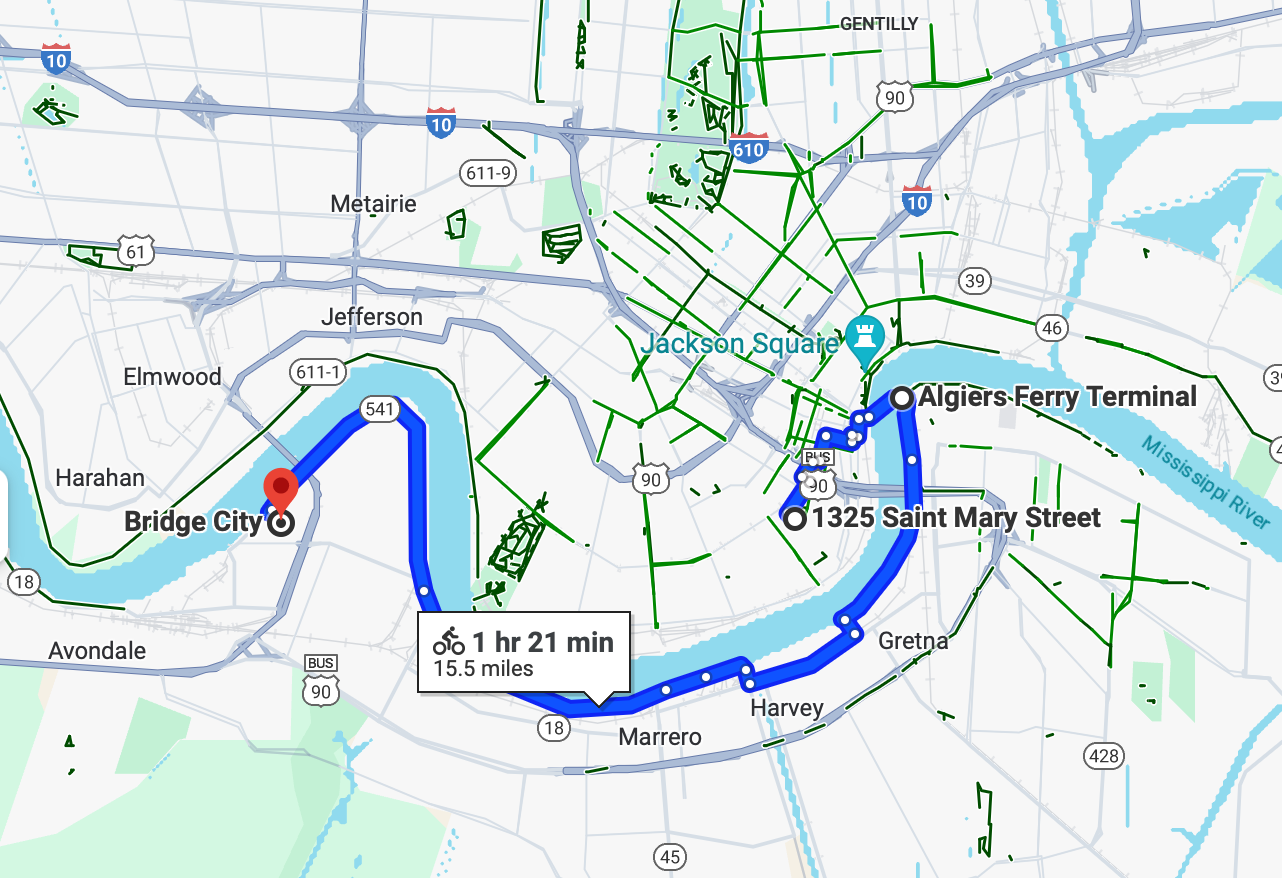
I remained fascinated by my quick trip over to the West Bank and I wanted to do it again, this time by bicycle. Something about that Saturday morning in Gretna had juiced me to do this. Three days later on a cold sunny Tuesday with temperatures mostly in the forties I left home at 9:30 AM to bicycle to the Algiers ferry, then to Gretna, then onward to Bridge City, and then back.
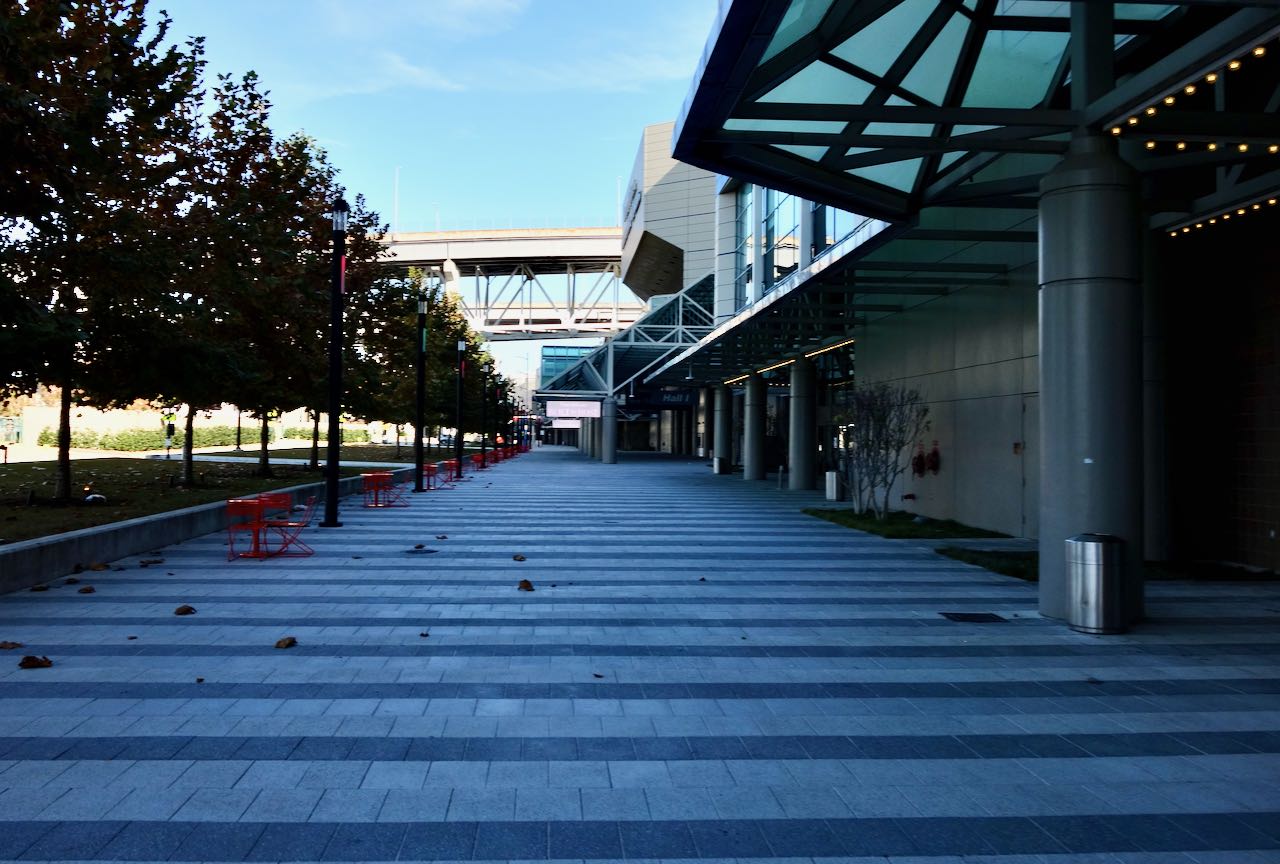
In New Orleans, as in almost everywhere in America, when bicycling you must choose your route carefully to keep cars from killing you. One of my favorite routes for the mile and a half between my condo and downtown’s Canal Street is to cycle under the bridge along the sidewalk in front of the mile-long riverfront convention center.
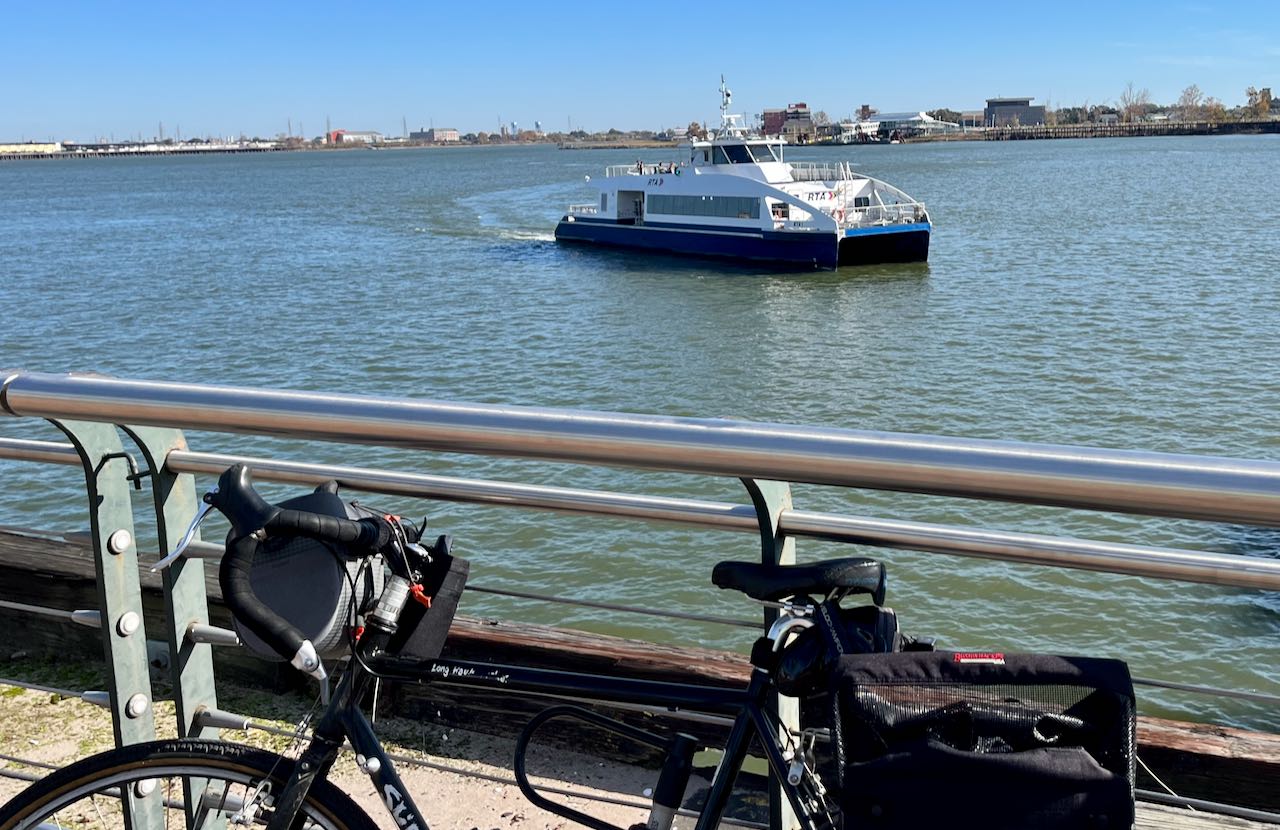
The Canal Street Ferry departs from a spot that has had ferry service for over two hundred years. About three years ago they acquired new faster catarmarans that no longer take cars. You pay just like a city bus and for a senior it only costs $1.00. Bringing a bicycle is painless. Once underway the crossing itself takes about five minutes. I cycled up to the ferry landing downtown.
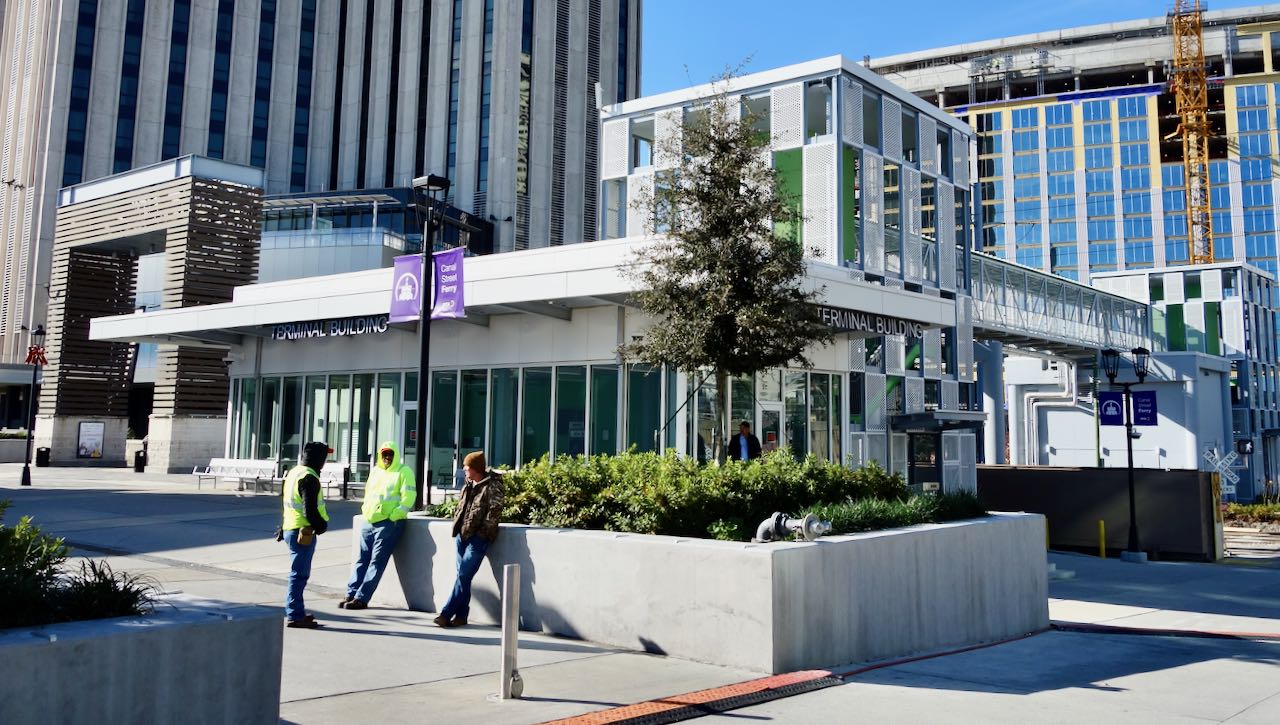
Ferry terminal buildings must be a good source of political pork in Louisiana. They are ubiquitous and mostly unused. With the small higher tech ferry hardly anyone needs to sit in a terminal building a hundred yards from where the watercraft stops. If the building were operating you would likely miss the ferry having to rush from the waiting room. On this weekday morning the brand new Canal Street building was locked and marked “closed.”
There is an unused and locked ferry terminal on the West Bank Algiers side as well. On arrival I wheeled the bicycle to the adjacent lovely paved bike trail that runs along the West Bank levee. I started cycling the three miles upstream towards central Gretna. I passed under the Crescent City Connection bridge.
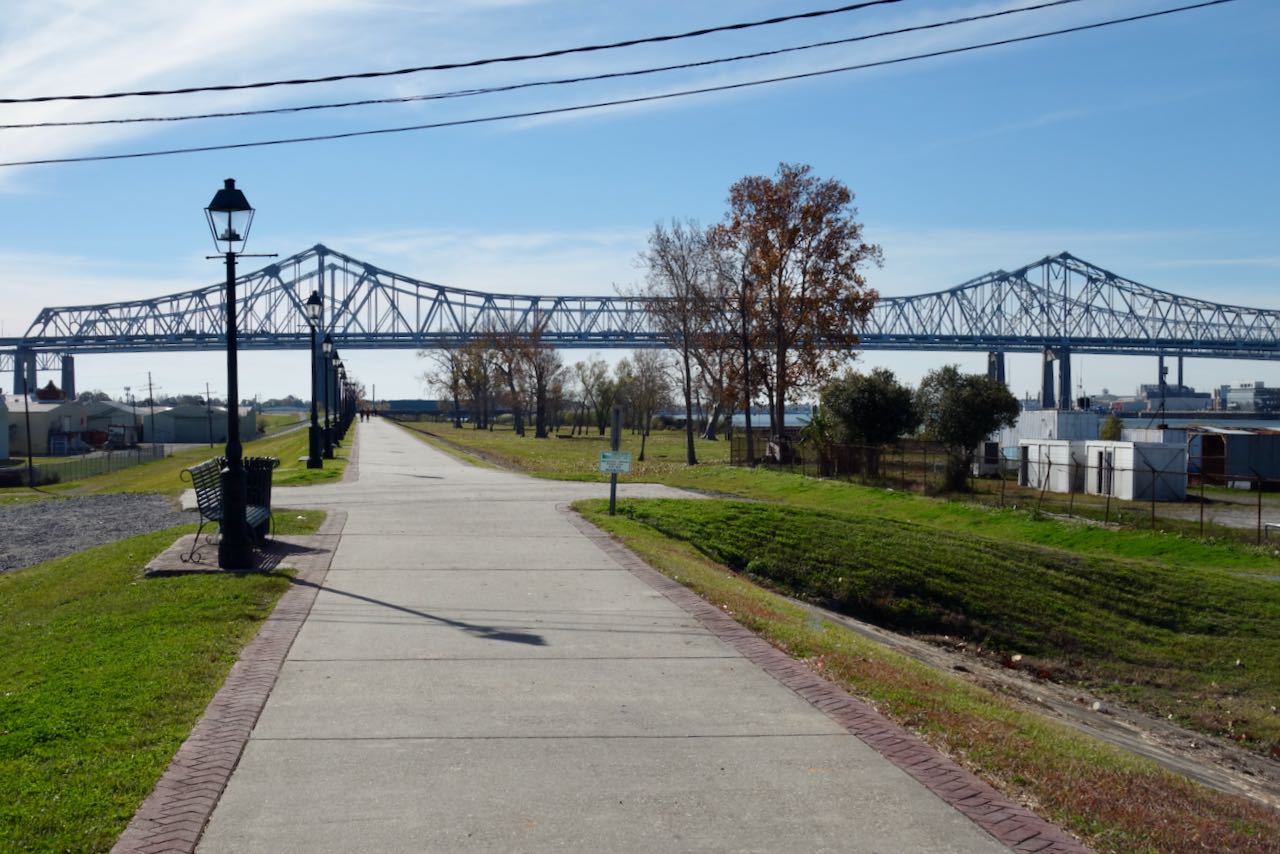
I looked back over the river to central New Orleans in the morning sunlight. Somebody had hung a rope swing in the batture.

The West Bank community of Algiers is a traditional New Orleans neighborhood of nineteenth century wooden houses. Compared to the city on the East Bank it seems quieter with less car traffic. This is a view from the levee.
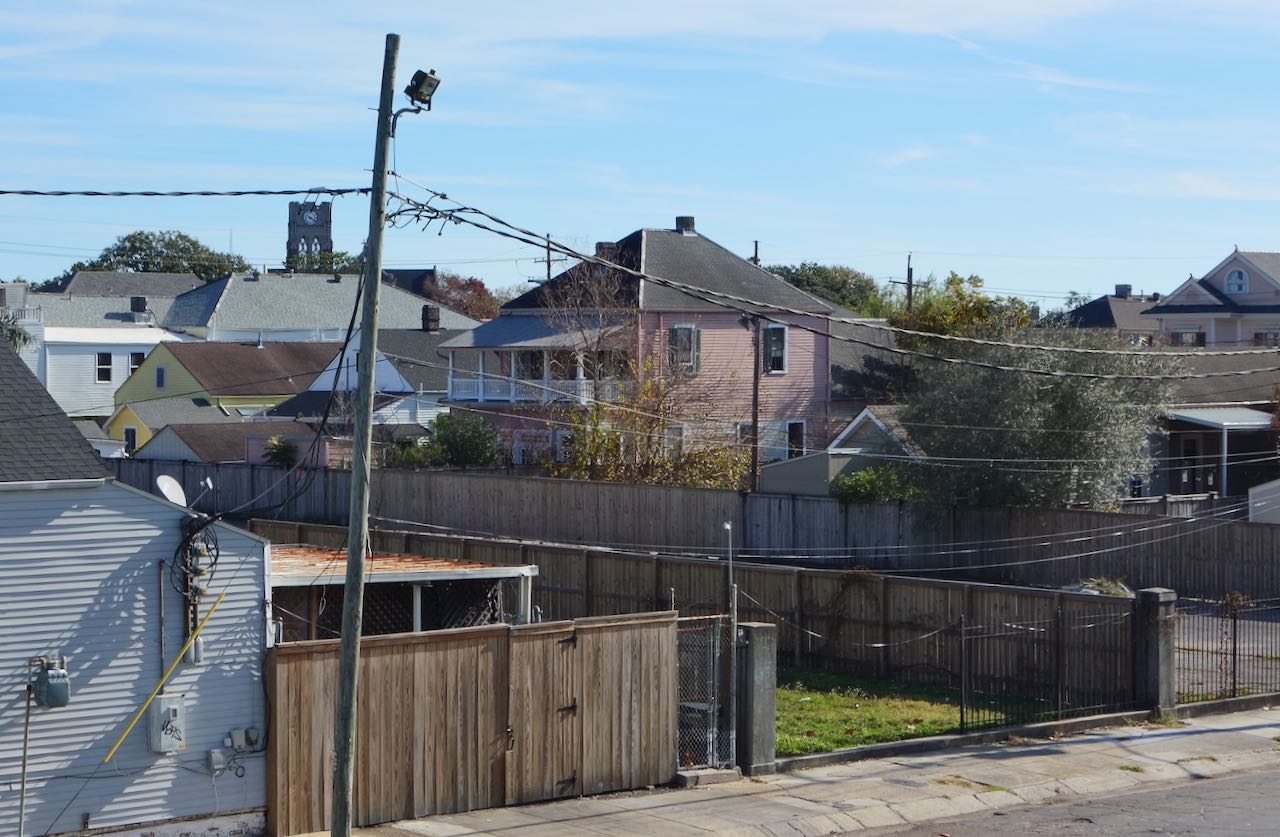
I cycled onward towards Gretna.
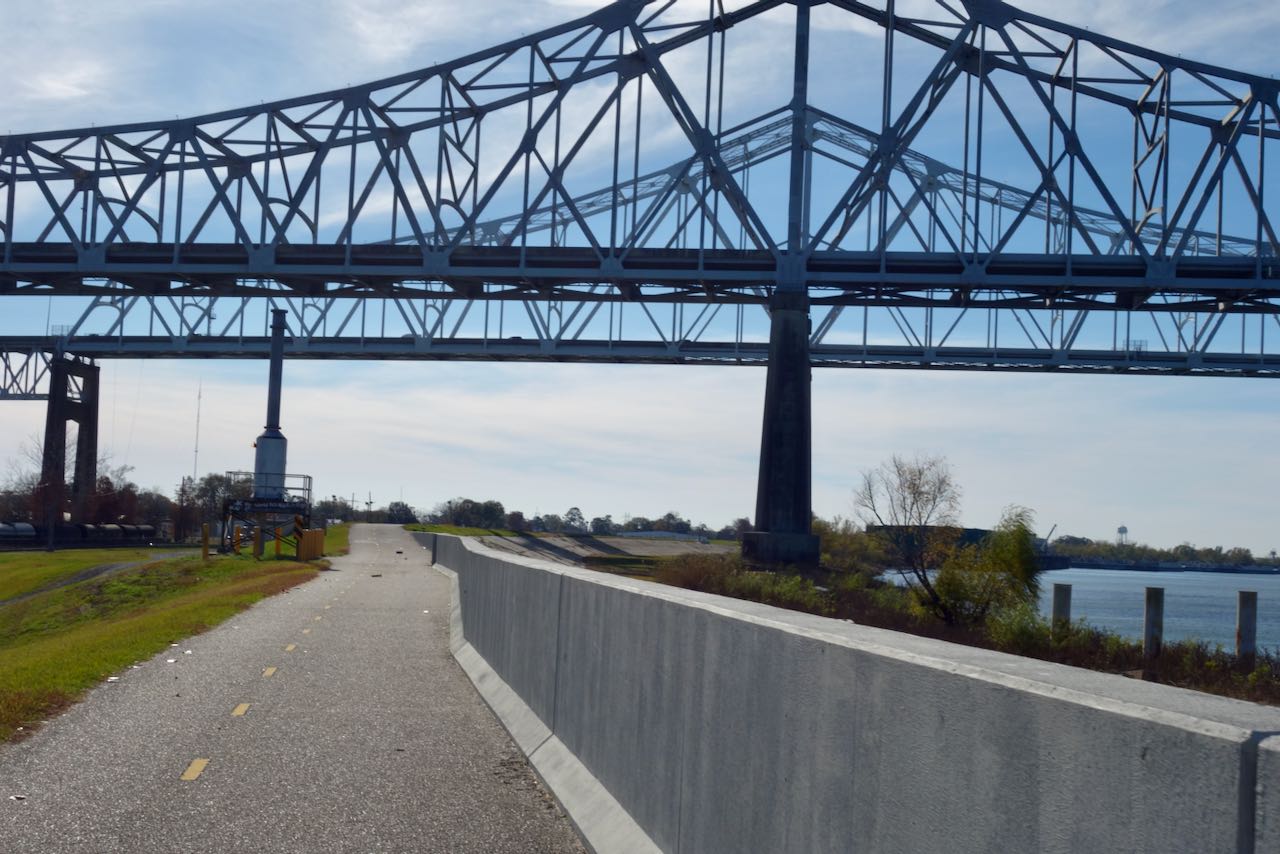
Gretna is just over the line into suburban Jefferson Parish and also where the levee bike path ends. On arrival I passed ANOTHER oversized empty and unused ferry terminal. There has not been a Gretna – Jackson Avenue ferry for over twenty years.

Side note: my friend Michael, who is in his seventies and still a working physician, grew up as one of ten children in a three room shotgun house in Gretna. He says for each of seven pregnancies his exceedingly pregnant mother walked from their Gretna house to the Gretna-Jackson Avenue ferry terminal, often alone. After crossing the river she walked several blocks to give birth at the Sara Mayo Hospital on Jackson Avenue in New Orleans. (That hospital building is currently being converted to condos.) While Gretna (population 18,000) is surrounded by suburban sprawl, the small part of Gretna near the courthouse has nineteenth century shotgun houses just like central New Orleans neighborhoods.
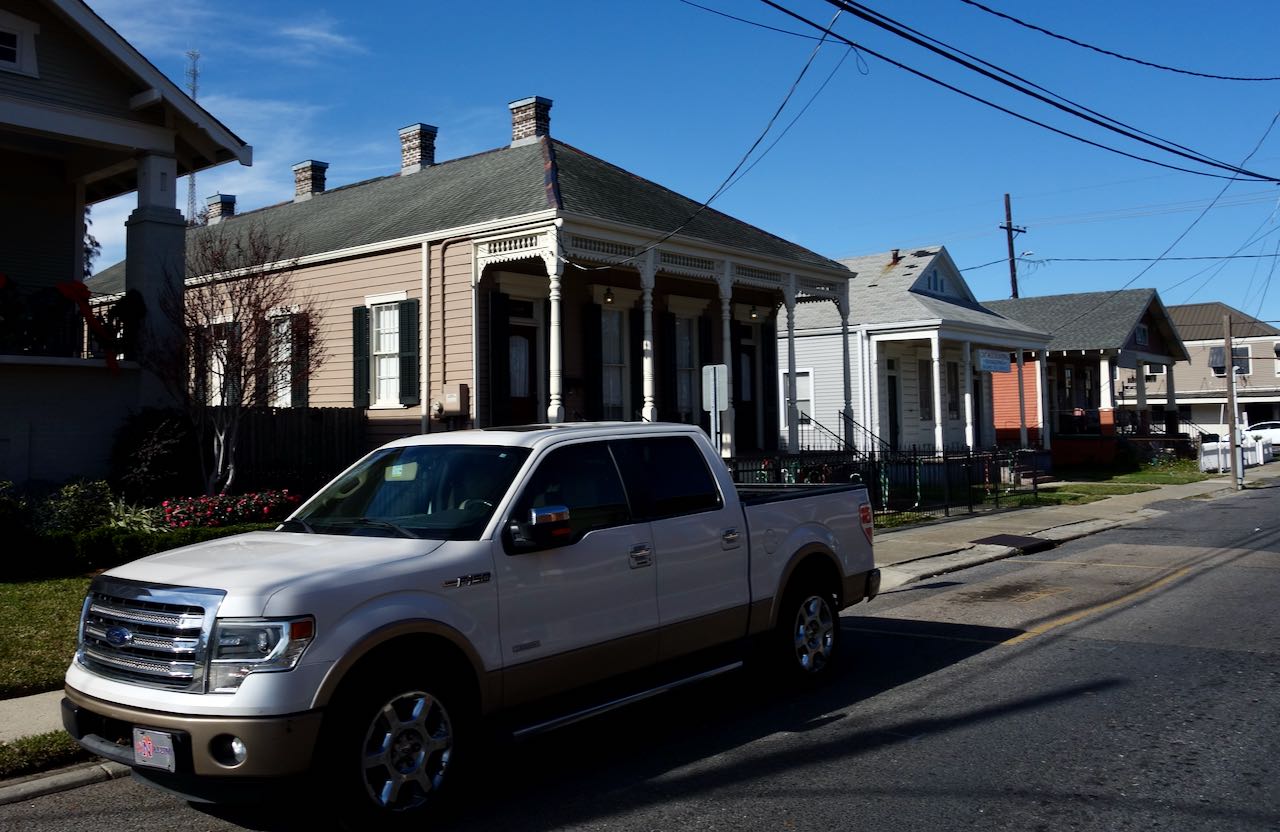
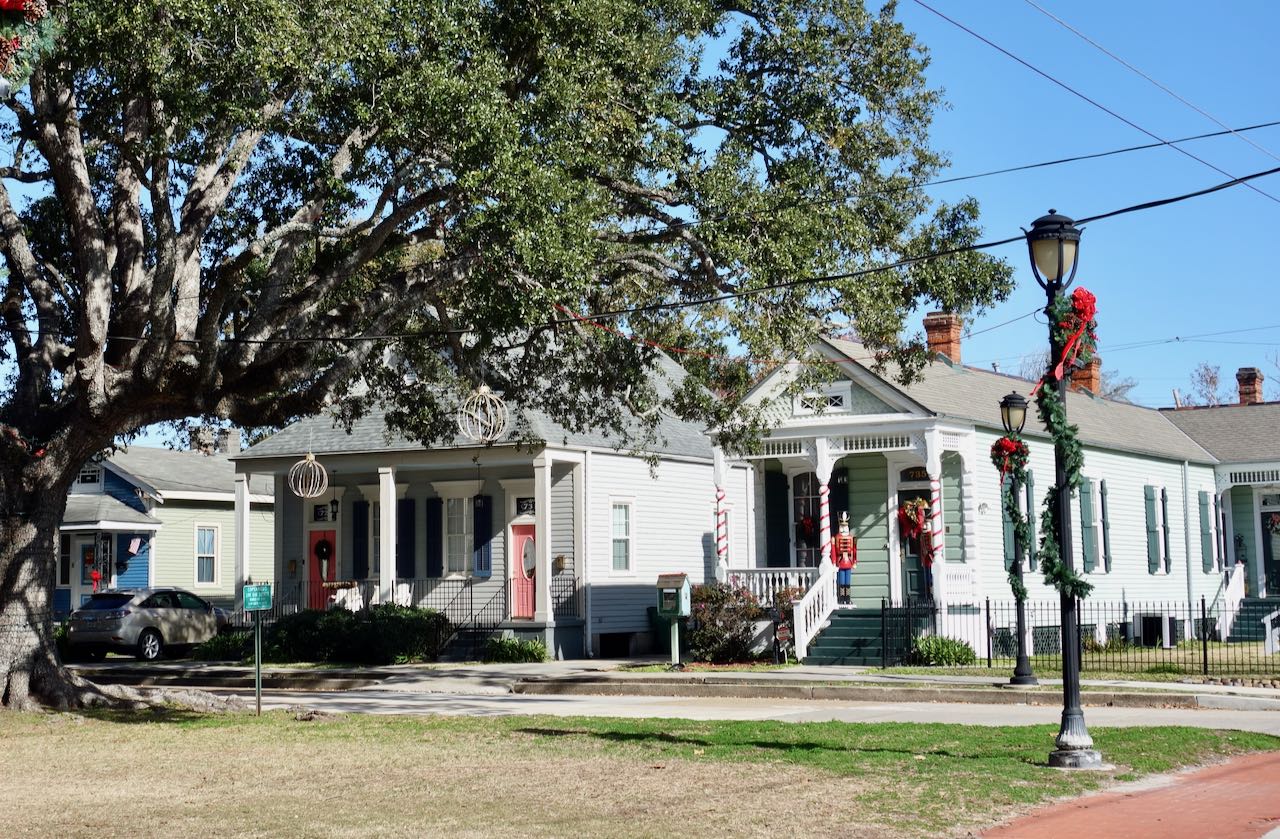
I had easily cycled from my Lower Garden District condo to old Gretna in not much more than an hour, including significant time spent waiting for the ferry. I certainly was not going to stop now. Cycling upriver I knew a levee bike path would restart in just a few miles. I passed through Gretna streets, then into neighboring Harvey LA. The only clue that I was in Jefferson Parish is that the street signs are green instead of blue.

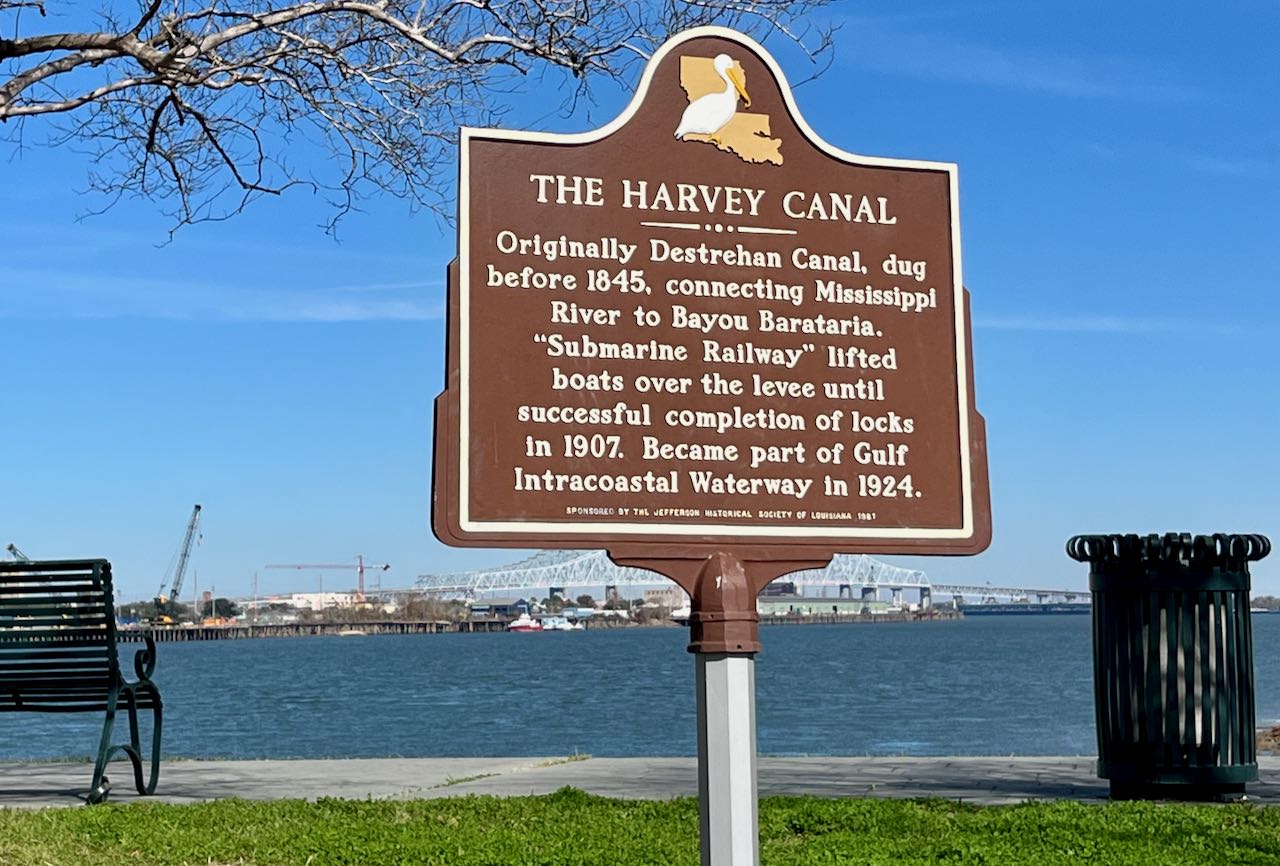
The small bridge on Fourth Street allows a relatively safe way for a bicyclist to cross the Harvey Canal, which intersects the Mississippi River. New Orleans area geography is dominated by that river which would not continue to flow southward if it were not above sea level. The open Gulf of Mexico is still almost a hundred miles downstream. The water level in bayous that thread through the surrounding marshes is at sea level, several feet lower. This creates a problem for canals which have been dug over the past two hundred years. To allow boats to access the river from surrounding bayous there would need to be locks to lift boats up several feet. It also reminds us that it would be catastrophic if the river ever broke through the levee at any spot.
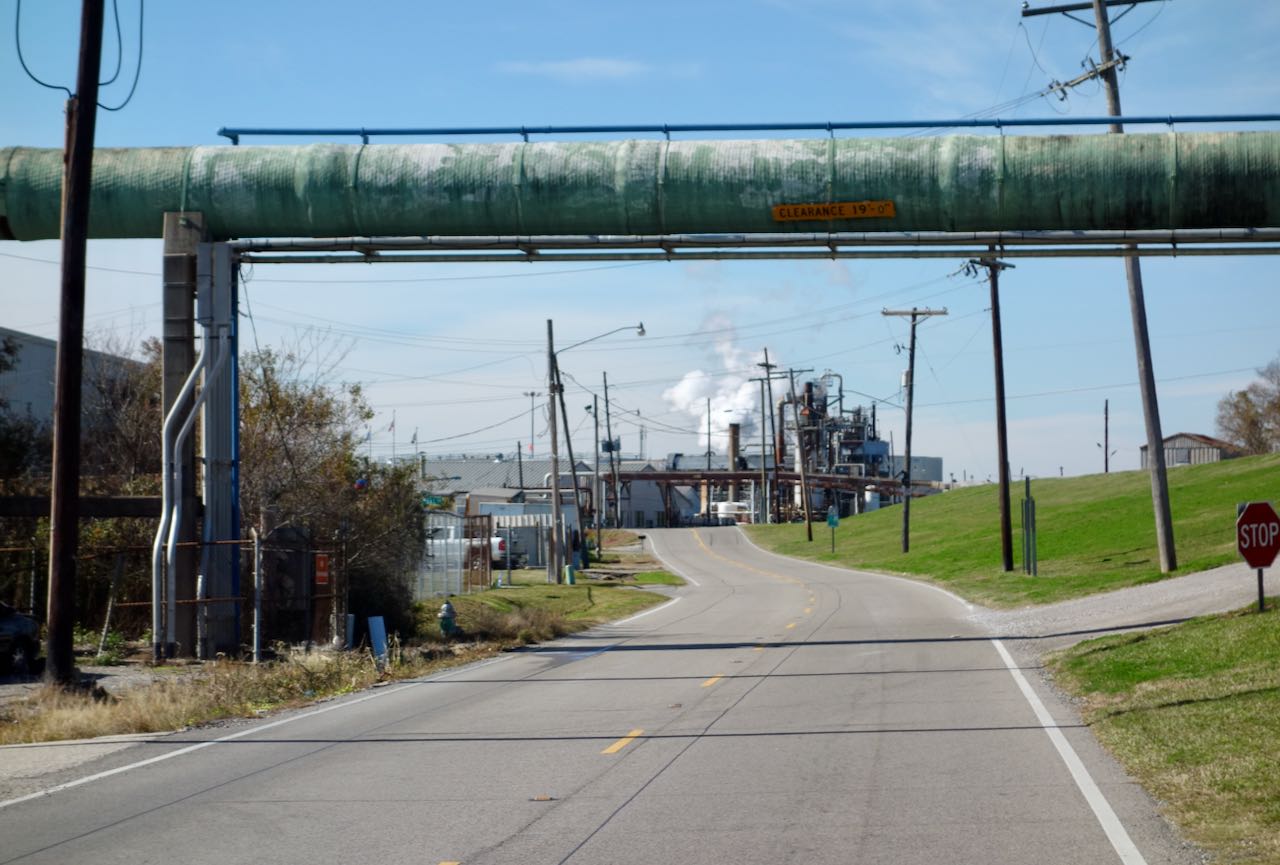
The levee bike path had not yet started again and I cycled on River Road as it passed through chemical plants and refineries that line the river. Fortunately this small section of the road carries little car traffic.

About five miles from Gretna the paved trail along the top of the levee restarts. It made for more relaxed cycling. Perhaps because the trail mostly passes through petrochemical plants, or because it was a cold day, I saw essentially not one person my entire time on this section of path, cyclist or pedestrian. This is a view of the path, looking back. It would be an additional eight miles to my proposed turnaround point of Bridge City.

Cycling onto a bend in the river called Nine Mile Point I saw Huey Long Bridge in the distance.
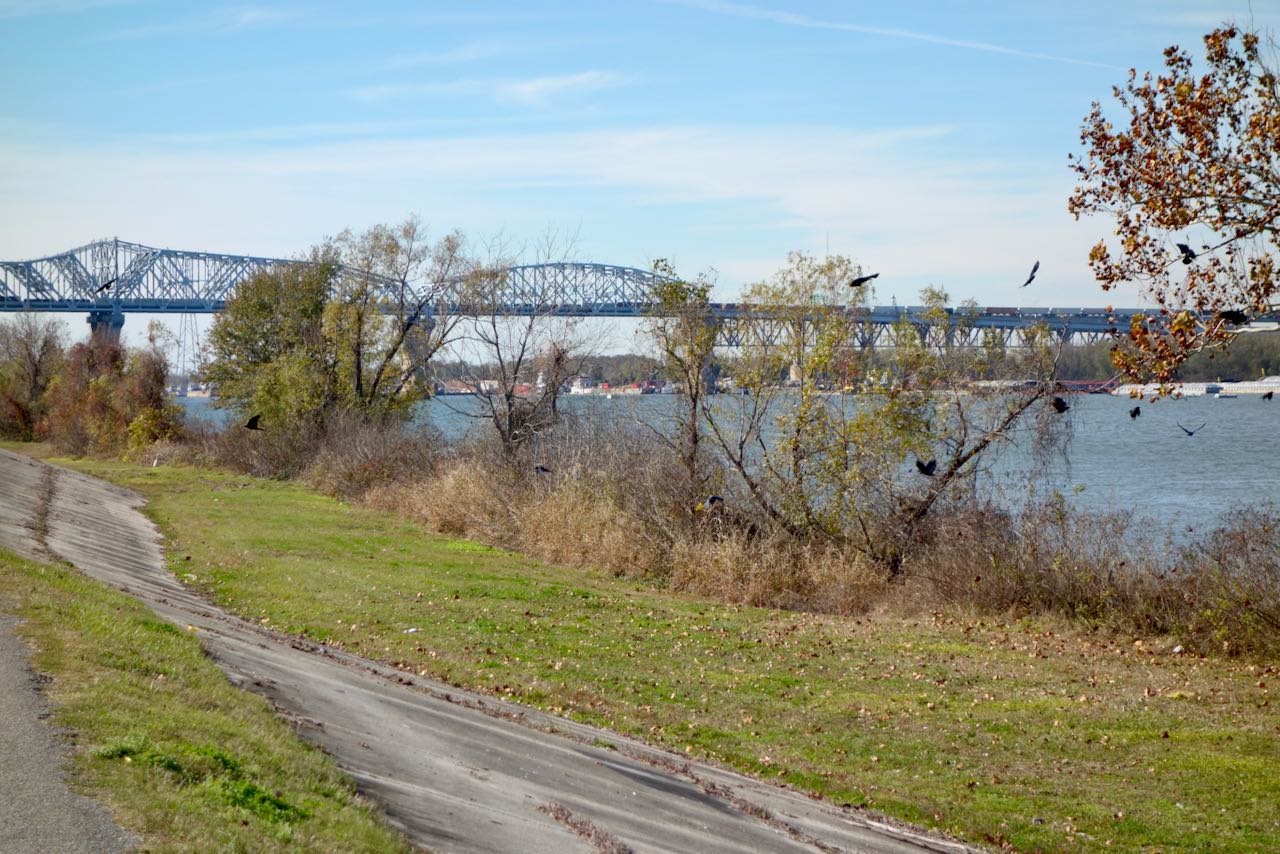
After passing under the bridge I looked back.

I did descend off the levee into Bridge City (population 7,300) because I wanted to still have lunch at a reasonable hour. Bridge City was built from scratch in 1935 to house bridge workers. Near Bridge City and the Avondale shipyards the West Bank levee bike path abruptly ends.

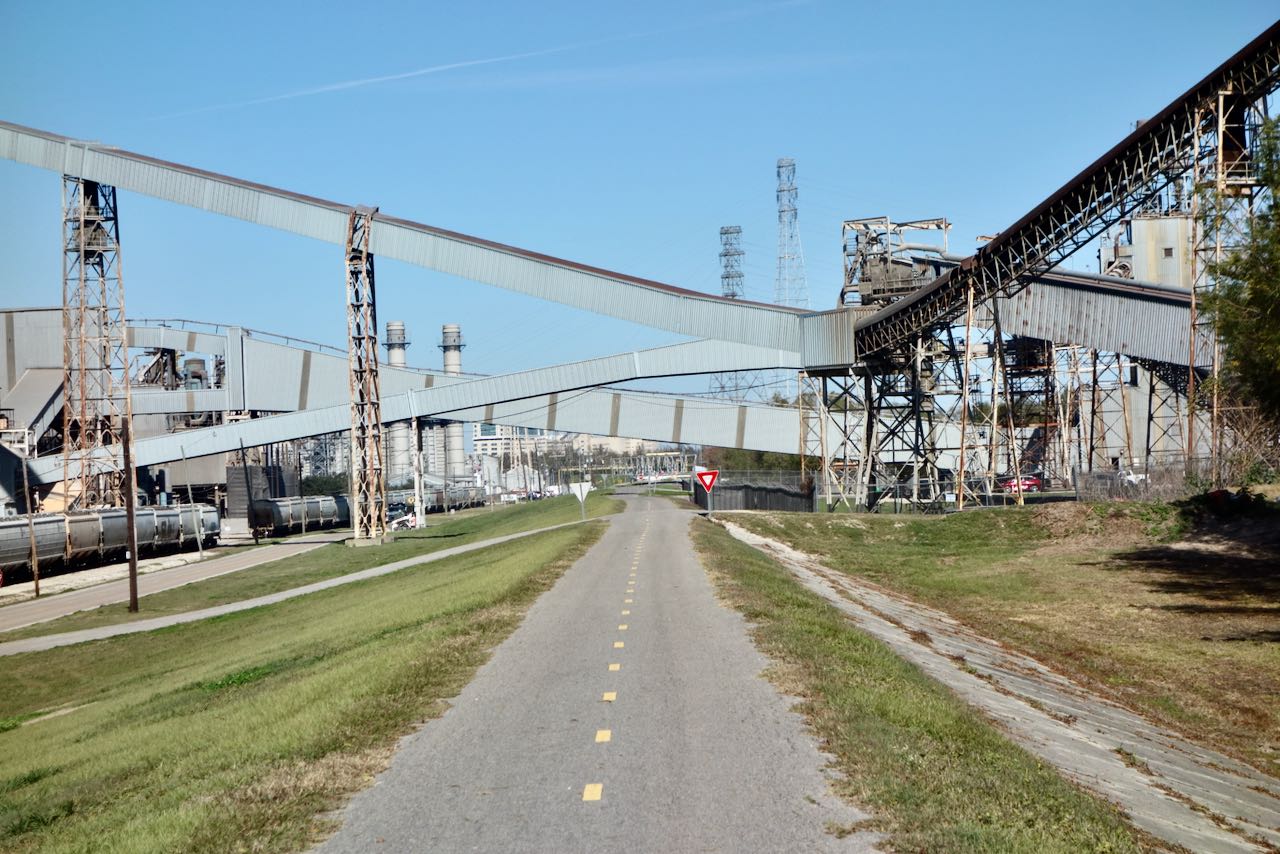
I had cycled to Bridge City faster than I had expected. I had seen no decent looking restaurants upriver of Gretna. I had brought a peanut butter and jelly sandwich, on Dave’s bread, but now it might be early enough to return to Gretna for an interesting meal somewhere. I bicycled back, passing again through miles of petrochemical plants and grain loading facilities.
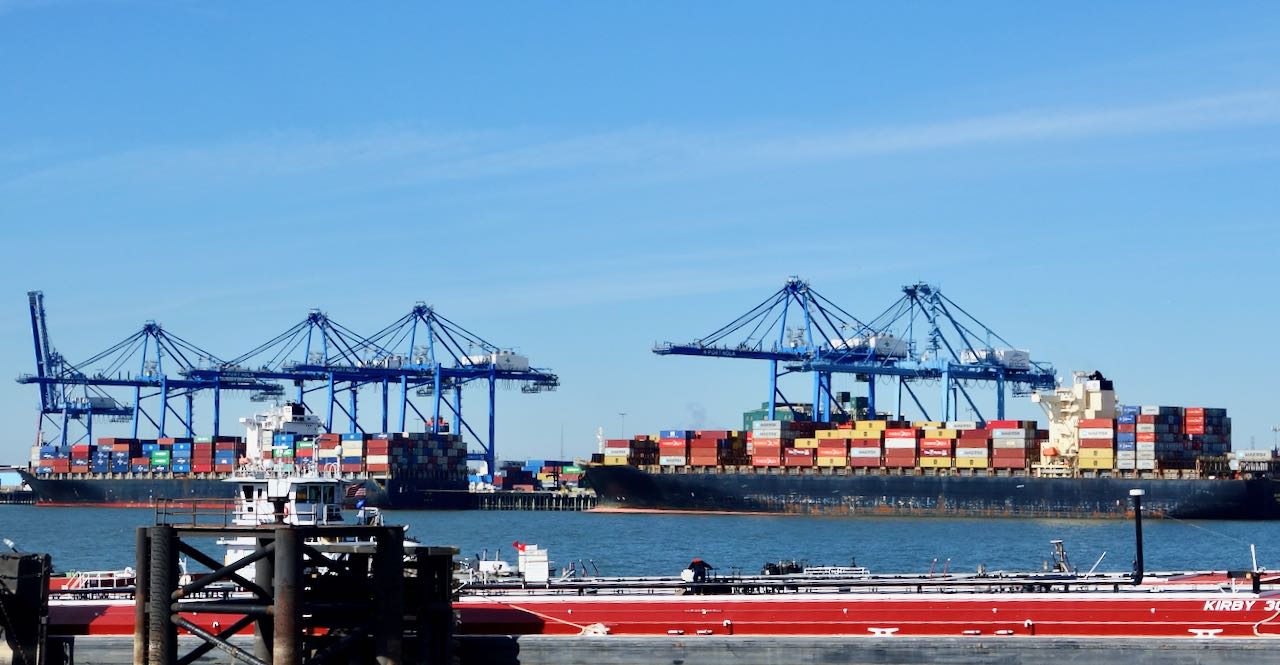
When passing Uptown New Orleans on the opposite bank, looking across the river I could see large container ships loading at Nashville Avenue Wharf.
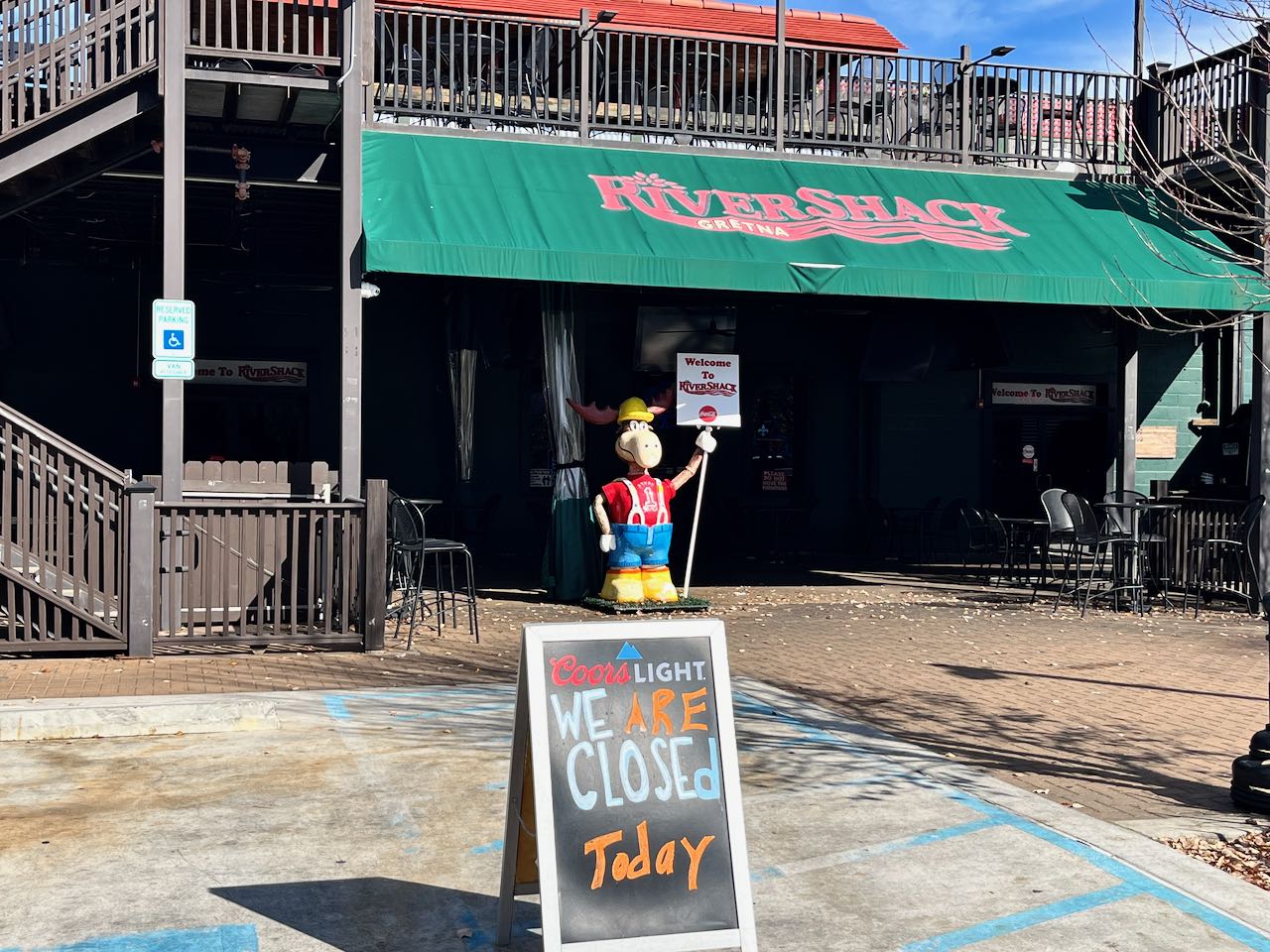
I cycled quickly down the levee bike path, then on River Road, then through the streets of Harvey and Gretna. By 1:30 PM I arrived at a place I knew has good poor boys; RiverShack which sits right at the levee in the older section of Gretna. Closed Today.
Rats! I would have to try something new. What about Gretna Depot?

I think of restaurants like this as Vic and Nat’ly places, modeled after the cartoon strip by the late Bunny Matthews that ran in the weekly News & Observer magazine section in the 1980’s. Vic and Nat’ly ran a small working class bar/restaurant serving traditional New Orleans fare, especially fried seafood. I stole this frame from Google Images
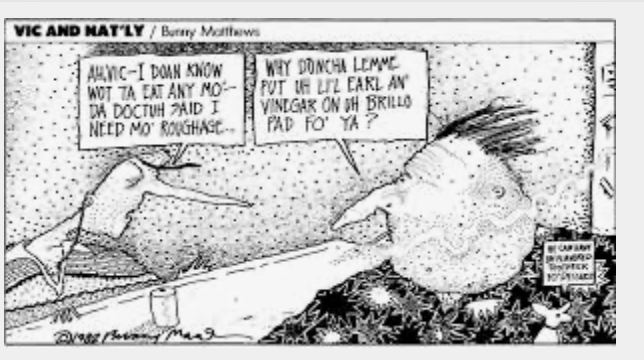
New Orleans proper, with its influx of moneyed people from elsewhere and the continued departure of blue and pink collar people to the suburbs, has fewer and fewer of these type bar restaurants. Domilises in Uptown still soldiers on, but they continue to thrive in places like Gretna and Metairie.
The Gretna Depot is one such place. There were open tables but I took a seat at the eight or nine seat bar. At that bar were two other people, a guy who looked very much like The Rock, with multiple gold chains around his neck, and a heavy set woman with significant eye shadow.
The menu offered a lunch option of Piece of Fried Fish with Cup of Gumbo. It fit the bill perfectly, along with an Abita Amber beer. Packaged saltines! The fish was perfectly crispy.
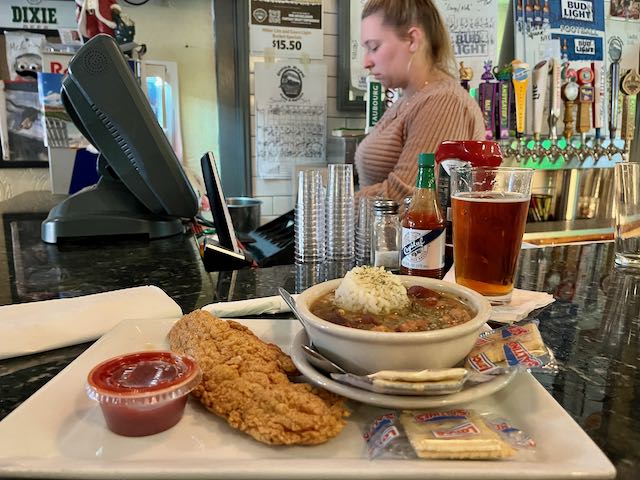
The food at Gretna Depot was satisfying but so was the cultural experience. Not only are these type of restaurants fading in Orleans Parish, in New Orleans one hears fewer and fewer Vic n Natly accents, the Brooklynesque dialect spoken by working class people who used to be derogatorily referred to as Yats. (they say “where y’at?”) An older White guy ambled up to the bar and started filling out the bar’s Saints weekly betting sheet. An older Black guy came up also. Their discussion of NFL football took place three feet from me. They spoke each in separate dialects but totally seemed to understand each other. I could barely understand any of it. It did seem like another language, or languages.
I paid my tab and ambled out onto the street facing the now empty central Gretna market building, the same one where I had bought farmer’s market produce that Saturday morning three days earlier.

I was in Gretna but live in the Lower Garden District, New Orleans. I bicycled up onto the levee. I was three miles away from the ferry in Algiers that would take me home.

 urban bicycle journeys
Leave a reply to cindy haydel Cancel reply